
How to optimize website for conversions is at the heart of turning casual visitors into paying customers. With a structured approach that combines conversion rate optimization (CRO), website usability improvements, and strategic digital marketing, businesses can transform their online presence from good to great. Here’s a quick guide:
- Understand Your Audience: Collect data on user behavior to tailor your site to their needs.
- Improve Usability: Ensure a seamless and intuitive user experience. Simplify navigation and fine-tune your landing pages for better engagement.
- Test and Iterate: Use A/B testing to refine CTAs and content placement.
- Improve Trust: Add customer testimonials and clear contact information to build credibility.
- Optimize Checkout: Simplify the purchase process to reduce cart abandonment.
Mastering how to optimize website for conversions is crucial to ensuring your digital efforts effectively capture and nurture your audience’s attention.
As Guy Leon, founder and CEO of Guac Digital, I’ve led efforts to boost client engagement and website performance by applying strategic CRO and custom digital solutions. Transitioning from understanding CRO basics to advanced strategies, you’re about to find techniques that could revolutionize your digital success.

Simple guide to how to optimize website for conversions terms:
– conversion optimization for ecommerce website
– conversion optimized website
Understanding Conversion Rate Optimization
Conversion Rate Optimization (CRO) is a powerful tool in digital marketing. It focuses on increasing the percentage of visitors who take a desired action on your website, like making a purchase or signing up for a newsletter. Understanding CRO fundamentals is essential for turning more visitors into customers.
CRO Fundamentals
At its core, CRO is about understanding your audience’s behavior and preferences. This involves studying how visitors interact with your site and identifying barriers to conversion. By addressing these barriers, you can improve the likelihood of conversions.
A critical part of CRO is conversion tracking. This involves setting up systems to monitor how users move through your site and where they drop off. Tools like Google Analytics are invaluable here, offering insights into user behavior and helping you pinpoint areas for improvement.
Conversion Tracking
To track conversions effectively, you need to define what a conversion means for your business. Is it a sale, a form submission, or perhaps a download? Once defined, you can set up goals in your analytics tool to track these actions.
For example, if you run an ecommerce store, you might track steps in the checkout process to identify where potential customers abandon their carts. This data is crucial for making informed decisions about where to focus your optimization efforts.
User Experience
A seamless user experience (UX) is vital for successful CRO. A website that’s easy to steer and visually appealing can significantly impact conversion rates. Focus on creating a user-friendly design that guides visitors smoothly towards conversion.
Simplifying navigation is one way to improve UX. Ensure that your site is intuitive, with clear pathways to essential pages. Fast page load times are also crucial, as slow sites can frustrate users and lead to higher bounce rates.
Moreover, mobile optimization is a must. With more people browsing on their phones, ensuring your site performs well on mobile devices can dramatically boost conversions.
In summary, mastering CRO involves a blend of understanding user behavior, effective tracking, and enhancing user experience. By focusing on these areas, you can significantly improve your website’s ability to convert visitors into customers.
Next, we’ll explore Key Strategies for Website Conversion Optimization, diving deeper into user feedback, competitor analysis, and the conversion funnel.
How to Optimize Website for Conversions
Understanding user behavior is the first step in optimizing your website for conversions. By observing how visitors interact with your site, you can identify patterns and obstacles that affect their decision-making process. Tools like heatmaps and session recordings offer valuable insights into where users click, how far they scroll, and where they abandon the site. This data helps you understand what elements might be causing friction in the user journey.
Once you have a handle on user behavior, it’s time to implement A/B testing. This method allows you to compare two versions of a webpage to see which one performs better. For instance, you might test different headlines, images, or layouts to determine what resonates best with your audience. Even small changes can lead to significant improvements in conversion rates. As noted in the research, a real estate company improved their CTA clicks by 44.11% simply by changing the text from “Contact us” to “Inquire now.”
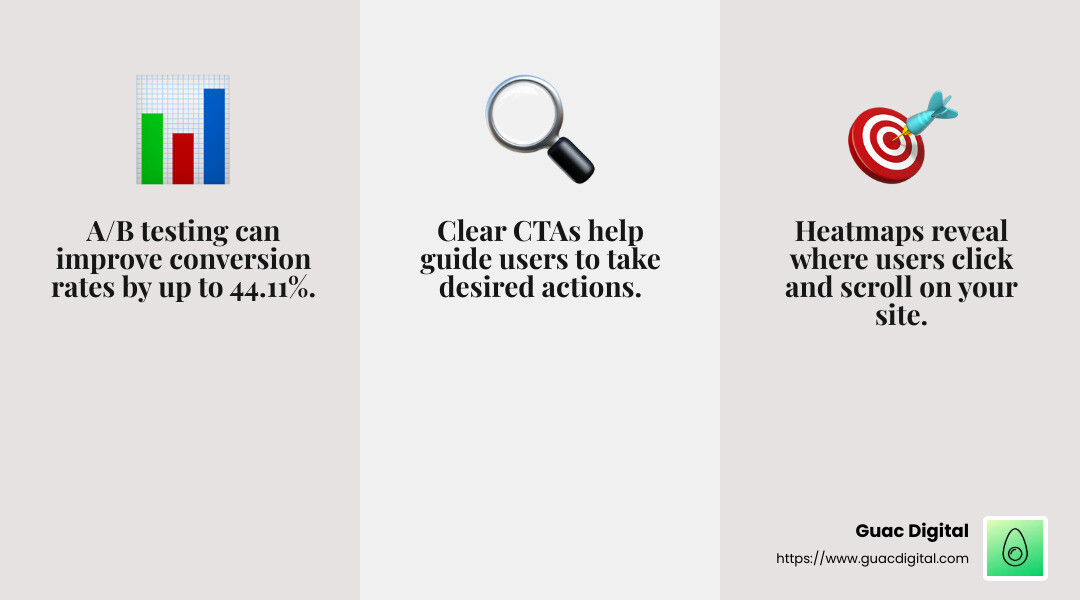
Clear CTAs (Call to Actions) are crucial in guiding users toward conversion. Your CTAs should be prominent and compelling, encouraging visitors to take the next step. Use contrasting colors to make them stand out, and ensure the text is direct and action-oriented. For example, instead of a vague “Submit,” try something more specific like “Get Your Free Quote.” This clarity helps reduce ambiguity and nudges users to act.
Incorporating these techniques—understanding user behavior, implementing A/B testing, and crafting clear CTAs—will set the foundation for a higher conversion rate. By continuously refining these elements, you can create a website that not only attracts visitors but also converts them into loyal customers.
Next, we’ll dig into Key Strategies for Website Conversion Optimization, where we explore the importance of user feedback, competitor analysis, and the conversion funnel.
Key Strategies for Website Conversion Optimization
When it comes to website conversion optimization, understanding your users and your competition is key. Let’s explore three critical strategies: gathering user feedback, performing competitor analysis, and analyzing your conversion funnel.
User Feedback
Listening to your users is one of the most effective ways to improve your website. User feedback helps you understand what visitors like and dislike about your site. You can gather feedback through:
- Surveys: Ask visitors about their experience and what improvements they’d like to see.
- Live Chat: Engage in real-time conversations to address concerns and gather insights.
- Customer Reviews: Analyze reviews to identify common pain points and areas for improvement.
By acting on this feedback, you can make changes that directly address user concerns, leading to an improved user experience and higher conversion rates. As the research highlights, companies that leverage user feedback often see significant improvements in user satisfaction and conversion metrics.
Competitor Analysis
Understanding what your competitors are doing can provide valuable insights into what works and what doesn’t. Here’s how to perform an effective competitor analysis:
- Identify Competitors: List your main competitors and visit their websites.
- Analyze Their Strategies: Look at their design, CTAs, and product offerings. What are they doing differently?
- Highlight Your USPs: Use this information to emphasize your unique selling points (USPs) that set you apart.
By understanding your competitors’ strengths and weaknesses, you can position your website to better meet customer needs. As noted in the research, competitor analysis can reveal opportunities for differentiation and improvement.
Conversion Funnel
Analyzing your conversion funnel is crucial to understanding where potential customers drop off. Here’s how to optimize it:
- Map the Funnel: Identify each step a user takes from landing on your site to completing a conversion.
- Identify Drop-off Points: Use tools like Hotjar to see where users abandon the process.
- Test and Refine: Implement A/B testing to try different strategies at each stage to see what reduces drop-offs.
For example, Gogoprint finded a design issue on their pricing page that was causing drop-offs. By addressing this, they decreased the drop-off rate by 7% and increased conversions by 2%.
By focusing on user feedback, competitor analysis, and the conversion funnel, you can create a more effective strategy to optimize your website for conversions. These strategies not only help in understanding your audience but also in creating a seamless journey that encourages them to become customers.
In the next section, we’ll explore the Top 5 Techniques to Boost Conversion Rates, including A/B testing, user personas, and more.
Top 5 Techniques to Boost Conversion Rates
When it comes to boosting your website’s conversion rates, there are five key techniques that stand out: A/B testing, user personas, value proposition, page load time, and mobile optimization.
1. A/B Testing
A/B testing is a powerful tool for understanding what works on your website. By comparing two variations of a page or element, you can see which version performs better. For instance, China Expat Health increased their lead conversion rate by 79% by simply changing their headline to convey a stronger value proposition.
Here’s how to get started with A/B testing:
- Choose a Variable: Test one element at a time, like a headline or CTA button.
- Create Variations: Develop two versions, A (control) and B (test).
- Analyze Results: Use data to determine which version yields better conversions.
A/B testing allows you to make informed decisions based on real user behavior, not assumptions.
2. User Personas
Creating user personas helps you understand your target audience. By knowing who your users are, you can tailor your website to meet their needs.
Consider the following when building personas:
- Demographics: Age, gender, location, etc.
- Pain Points: What problems are they trying to solve?
- Goals: What do they hope to achieve by visiting your site?
With detailed personas, you can craft content and design elements that resonate with your audience, leading to higher conversion rates.
3. Value Proposition
Your value proposition is what sets you apart from competitors. It answers the question: Why should a visitor choose you over someone else?
To define a strong value proposition:
- Be Clear and Concise: Clearly state the benefits of your product or service.
- Use Testimonials: Support your claims with customer reviews and success stories.
- Highlight Unique Benefits: Emphasize what makes you different and better.
A compelling value proposition can significantly increase conversions by immediately conveying the benefits to potential customers.
4. Page Load Time
Page load time is crucial for keeping visitors on your site. A slow-loading page can frustrate users and lead them to abandon your site.
To improve load times:
- Optimize Images: Compress images to reduce file sizes.
- Use a Content Delivery Network (CDN): Speed up content delivery.
- Minimize HTTP Requests: Reduce the number of elements on a page.
Research shows that even a one-second delay in page load time can result in a 7% reduction in conversions.
5. Mobile Optimization
With more users accessing websites on mobile devices, mobile optimization is essential. A mobile-friendly site ensures a seamless experience for all users.
Steps to optimize for mobile:
- Responsive Design: Ensure your site adjusts to different screen sizes.
- Simplified Navigation: Make it easy for users to find what they need.
- Fast Load Times: Prioritize speed on mobile devices.
Given that mobile users account for a significant portion of web traffic, optimizing for mobile can lead to a substantial increase in conversions.
By implementing these five techniques, you can effectively boost your website’s conversion rates and turn more visitors into customers.
In the next section, we’ll address some Frequently Asked Questions about Website Conversion Optimization, providing insights into best practices and strategies.
Frequently Asked Questions about Website Conversion Optimization
How to optimize website conversion rate?
Optimizing your website’s conversion rate is all about turning more visitors into customers. Here are some CRO best practices to get you started:
- Understand User Behavior: Use tools like heatmaps and session recordings to see how visitors interact with your site. This insight helps you identify areas for improvement.
- Clear Call-to-Actions (CTAs): Make your CTAs stand out with contrasting colors and action-oriented text. For example, Bombas increased logins by 36% by changing their login CTA from an icon to text.
- A/B Testing: Test different versions of your pages to see which performs better. Focus on one element at a time, like headlines or button colors, to get clear results.
How to optimize for conversions?
To optimize for conversions, focus on these key areas:
- Conversion Tracking: Set up goals in tools like Google Analytics to track actions that matter, such as form submissions or purchases. This data helps you measure success and adjust strategies.
- Specific Keywords: Use targeted keywords that match user intent. This ensures that your content attracts the right audience, increasing the likelihood of conversion.
- Negative Keywords: In paid advertising, negative keywords prevent your ads from showing up in irrelevant searches, saving budget for more qualified leads.
How do I make my website high conversion?
Creating a high-converting website involves several strategies:
- Top-Performing Content: Identify and replicate content that drives the most engagement and conversions. This could be blog posts, videos, or product descriptions.
- Audience Understanding: Develop detailed user personas to tailor your website to meet their needs. Consider demographics, pain points, and goals to create relevant content and experiences.
- Competitor Analysis: Study your competitors to uncover their strengths and weaknesses. Use this information to highlight your unique selling points and improve your offerings.
By focusing on these areas, you can effectively improve your website’s conversion rate and drive more sales. In the next section, we’ll explore Guac Digital’s personalized strategies for achieving high ROI.
Conclusion
At Guac Digital, we’re all about changing your website visitors into loyal customers through personalized strategies. Our approach is rooted in leveraging big data and programmatic marketing to ensure high ROI for our clients.
Why Choose Guac Digital?
We understand that every business is unique. That’s why we craft custom digital campaigns that align with your brand’s identity and goals. Our team dives deep into your business’s core to create strategies that resonate with your target audience.
High ROI with Personalized Strategies
Data-Driven Insights: We use advanced analytics to gather insights about user behavior. This helps us identify what works and what doesn’t, allowing us to optimize your website for better conversions.
Custom Solutions: From user-friendly web design to strategic SEO, our services are customized to improve your online presence and drive conversions. By focusing on your specific needs, we ensure that every campaign maximizes your return on investment.
Continuous Improvement: We believe in the power of iterative testing and continuous optimization. By regularly analyzing performance data, we refine our strategies to keep up with changing trends and consumer preferences.
Our commitment to personalized strategies and data-driven marketing sets us apart. With a global reach and a base in Tampa, Florida, Guac Digital is your partner in achieving digital marketing success.
Ready to lift your digital presence? Explore our services and find how we can help you master website conversion optimization.