
Programmatic advertising ROI is a transformative concept in the digital marketing landscape, reshaping how businesses optimize their online ad spend for maximum return. This advertising approach automates the buy-sell process of ads using real-time data, enabling marketers to connect with highly targeted audiences. It’s clear why businesses are eager to leverage its potential. Here’s a concise breakdown to help you grasp the essence of this invaluable tool:
- Investment Output: Evaluate the revenues generated from each programmatic campaign.
- Cost Efficiency: Ensure that ad spending directly translates to measurable returns.
- Performance Insights: Utilize data-driven analytics to continually refine strategies.
My name is Guy Leon, founder and CEO of Guac Digital, an industry-leading marketing agency. Having enhanced client engagement and conversion rates through programmatic methods, I offer deep insights into maximizing programmatic advertising ROI. Join me as we delve deeper into this dynamic field.
Explore more about Programmatic advertising ROI:

Understanding Programmatic Advertising ROI
Calculating Programmatic advertising ROI is essential for understanding the effectiveness of your digital marketing efforts. It involves a simple formula:
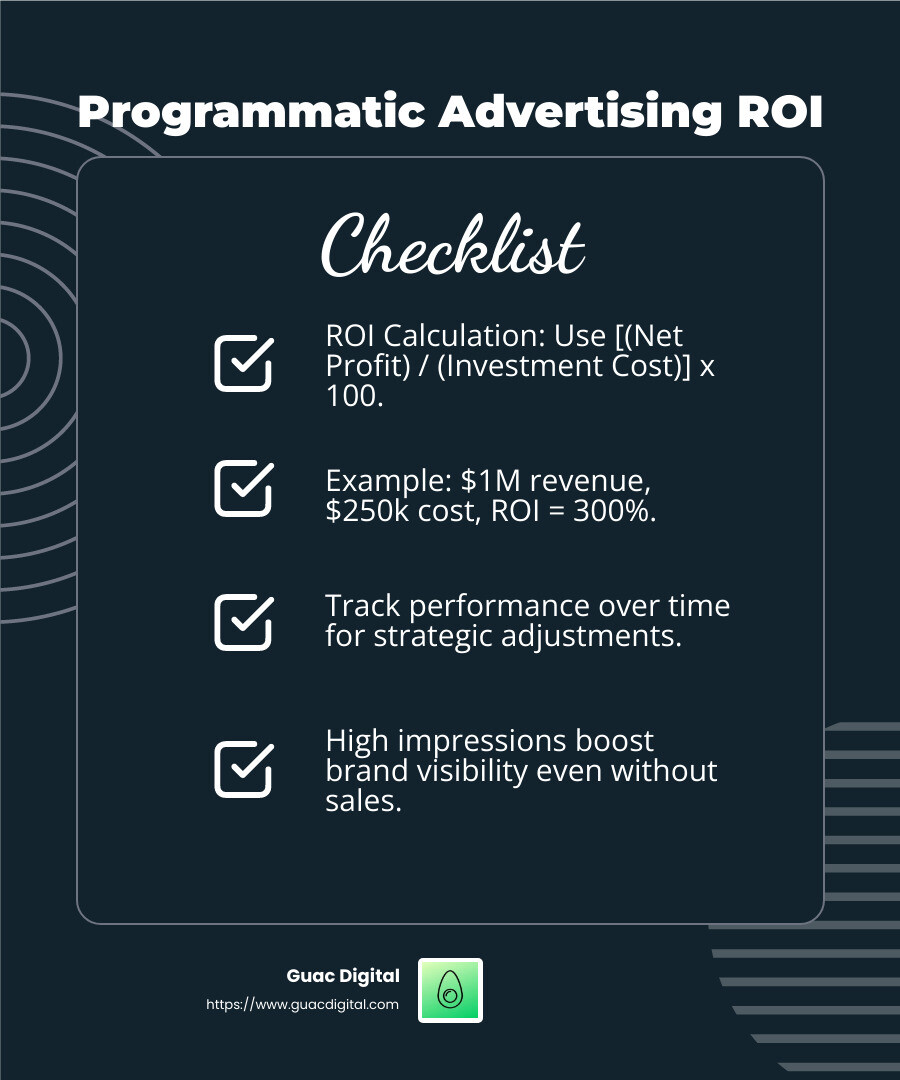
ROI (%) = [(Net Profit) / (Investment Cost)] x 100
To break it down, net profit is the revenue generated minus the initial investment. The investment cost is the amount spent on the programmatic ad campaign. For example, if you spend $250,000 on a campaign and it generates $1 million in revenue, your ROI calculation would look like this:
- Net Profit: $1,000,000 – $250,000 = $750,000
- ROI: ($750,000 / $250,000) x 100 = 300%
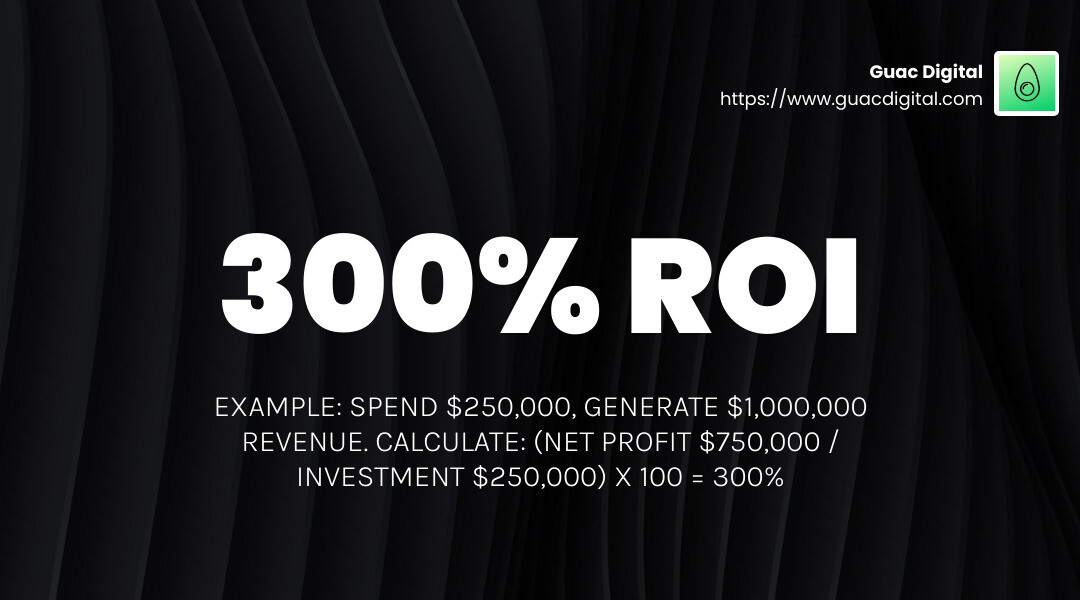
This calculation is crucial because it helps marketers understand the financial gains relative to the cost of their investment. It provides a clear picture of which campaigns are successful and which need adjustment.
Importance of ROI in Programmatic
Tracking ROI is not just about the numbers; it’s about aligning your marketing goals with tangible outcomes. Here’s why it matters:
Performance Tracking: Monitoring ROI allows marketers to track the effectiveness of their campaigns over time. It helps in identifying which strategies are driving results and which aren’t.
Brand Awareness: While ROI often focuses on financial returns, it also plays a role in measuring brand awareness. High impressions and engagement metrics, even without immediate sales, can indicate a successful campaign that improves brand visibility.
Customer Acquisition: By understanding ROI, businesses can pinpoint which channels and strategies are most effective for acquiring new customers. This is essential for optimizing future campaigns and ensuring that marketing dollars are well spent.
In the world of programmatic advertising, having a solid grasp of ROI ensures that your strategies are not just effective but also efficient. It’s about making data-driven decisions that lead to better outcomes.
Key Benefits of Programmatic Advertising
Programmatic advertising is not just a buzzword; it’s a powerhouse for digital marketing. Let’s explore its key benefits: efficiency and automation, precise targeting, and real-time optimization.
Efficiency and Automation
Programmatic advertising takes the grunt work out of ad buying. It automates ad placement and bidding, freeing up your team to focus on creativity and strategy.
Imagine a world where ads are bought and placed in milliseconds. That’s the reality with programmatic. It allows you to efficiently manage large-scale campaigns without the hassle of manual processes. This automation means you can reach more people faster and at a lower cost.
Precise Targeting
One of the standout features of programmatic advertising is its ability to target with laser precision. Using real-time data, you can reach specific demographics based on behavior and interests.
Consider this: instead of casting a wide net and hoping for the best, programmatic lets you zero in on your ideal audience. Whether you’re targeting tech enthusiasts or fashionistas, programmatic ensures your ads land in front of the right eyes.
By understanding user behavior and interests, you can create personalized ad experiences that resonate. This level of targeting boosts engagement and conversion rates, making your marketing efforts more effective.
Real-Time Optimization
In advertising, timing is everything. Programmatic advertising offers real-time optimization, allowing you to adjust campaigns on the fly.
With access to instant campaign insights, you can make data-driven decisions to improve performance. Spot a trend? Adjust your strategy. Notice an ad isn’t performing? Tweak it immediately. This agility helps avoid low-quality placements and maximizes your ad spend.
Real-time optimization ensures you stay ahead of the curve, adapting to consumer behaviors and market changes swiftly. It’s about being proactive, not reactive, in your advertising approach.
In summary, programmatic advertising’s efficiency, precision targeting, and real-time optimization are game-changers for marketers. These benefits not only streamline processes but also improve the effectiveness of your campaigns, ensuring a higher Programmatic advertising ROI.
Next, we’ll explore strategies to maximize your programmatic advertising ROI.
Strategies to Maximize Programmatic Advertising ROI
Maximizing Programmatic advertising ROI requires a strategic approach that leverages data, creativity, and audience insights. Let’s break down three key strategies: data integration, creative optimization, and audience segmentation.
Data Integration
Data is everywhere. But it’s not just about having data; it’s about using it effectively. Integrating disparate data sources is crucial for gaining comprehensive customer insights.
Imagine pulling data from various platforms—social media, web analytics, and CRM systems—and combining it into a single view. This integration provides a complete picture of your audience, enabling more informed decision-making.
For instance, a retailer could integrate online browsing data with in-store purchase history to understand customer preferences better. This holistic view allows for more accurate targeting and personalization, ultimately boosting your programmatic campaigns’ effectiveness.
Creative Optimization
Creativity plays a pivotal role in capturing attention and driving engagement. Creative optimization focuses on crafting emotional connections and delivering custom messaging that resonates with your audience.
Think of it this way: an ad that speaks directly to a consumer’s needs and desires is more likely to convert. By tailoring your creative content to different segments, you create a more personalized experience.
For example, a travel agency could use vibrant imagery and storytelling to evoke wanderlust in young triprs while highlighting relaxation and luxury for older audiences. This personalized approach improves the emotional impact, making your ads more memorable and effective.
Audience Segmentation
Understanding your audience is key to any successful marketing strategy. Programmatic advertising allows you to segment audiences based on demographics, behavior, and purchasing intent.
Consider segmenting your audience into distinct groups. For instance, a tech company might target early adopters with new gadget releases, while focusing on price-conscious buyers with promotional offers.
By tailoring your messaging to each segment, you ensure that your ads are relevant and engaging. This approach not only improves engagement but also increases the likelihood of conversion, maximizing your Programmatic advertising ROI.
In summary, integrating data, optimizing creative content, and segmenting your audience are vital strategies for enhancing programmatic advertising success. These tactics enable you to deliver more targeted, relevant, and impactful campaigns, ensuring a higher return on investment.
Next, we’ll dig into the latest trends and growth in programmatic advertising.
Programmatic Advertising Trends and Growth
Market Growth
Programmatic advertising is not just a trend—it’s a booming industry. The global market value for programmatic advertising is projected to skyrocket. By 2025, it’s expected to reach an astonishing $155 billion, marking a significant increase from previous years. This growth is driven by the increasing reliance on digital advertising and the need for efficient, automated ad buying processes.
One key metric to watch is the compound annual growth rate (CAGR). For programmatic advertising, the CAGR is impressive, showing a steady upward trajectory. This means more businesses are investing in programmatic solutions, recognizing their potential to deliver better ROI and performance.
Industry trends indicate a shift towards more personalized and targeted advertising. With the decline of third-party cookies, brands are focusing on first-party data and contextual targeting to reach their audiences effectively. This shift is reshaping how advertisers approach programmatic, emphasizing privacy and data protection.
Technological Advancements
Technological advancements are at the heart of programmatic advertising’s success. AI and machine learning are revolutionizing the way ads are bought and sold. These technologies enable real-time bidding and optimization, ensuring that ads reach the right audience at the right time.
Automation is another game-changer. It streamlines the entire ad buying process, from bidding to placement, reducing manual labor and allowing marketers to focus on strategy and creativity. With automated systems, advertisers can quickly adapt to changing market conditions and consumer behaviors.
The rise of connected TV (CTV) and over-the-top (OTT) platforms is opening new doors for programmatic advertising. As more consumers ditch traditional cable for streaming services, advertisers are following suit. CTV ad spend is projected to surge, reaching $27.5 billion by 2025. This shift offers brands new opportunities to engage with audiences through compelling video content.
In summary, the programmatic advertising landscape is evolving rapidly. Market growth is fueled by increased investment and the adoption of new technologies like AI and automation. As the industry continues to expand, staying ahead of these trends will be crucial for maximizing Programmatic advertising ROI.
Next, we’ll explore some frequently asked questions about programmatic advertising ROI.
Frequently Asked Questions about Programmatic Advertising ROI
What is a good ROI percentage for advertising?
A good ROI percentage in advertising can vary widely depending on the industry and the specific goals of a campaign. Generally, a marketing ROI of 5:1 is considered strong, meaning that for every dollar spent, five dollars are earned back. However, some industries may aim for even higher returns, especially in competitive digital markets where programmatic advertising is prevalent.
In programmatic advertising, the focus is often on optimizing the cost ratio to ensure that spending is efficient and yields the highest possible returns. This involves carefully tracking the performance of ads and adjusting strategies in real-time to maximize effectiveness.
What is the growth rate of programmatic advertising?
The compound annual growth rate (CAGR) of programmatic advertising is impressive, reflecting the industry’s rapid expansion. Current projections suggest that the global market value for programmatic advertising will reach $155 billion by 2025, driven by the increasing shift to digital platforms and the demand for automated ad buying.
This growth is supported by the adoption of advanced technologies like AI and machine learning, which enable more efficient and targeted advertising strategies. As more businesses recognize the potential for improved Programmatic advertising ROI, investment in these technologies continues to rise.
How does programmatic advertising work?
Programmatic advertising works by using automation and advanced algorithms to buy and place digital ads in real-time. This process involves several key components:
Real-time transactions: Programmatic advertising relies on real-time bidding (RTB) to purchase ad space. This allows advertisers to bid on impressions as they become available, ensuring that ads are shown to the right audience at the right time.
Data-driven targeting: By leveraging data from various sources, programmatic platforms can target specific demographics, behaviors, and interests, maximizing the relevance and impact of ads.
Optimization: Continuous optimization is a hallmark of programmatic advertising. Advertisers can adjust their campaigns on the fly based on performance metrics, ensuring that they get the best results for their investment.
Programmatic advertising streamlines the ad buying process, making it more efficient and effective. This enables brands to improve their reach and engagement while maximizing their Programmatic advertising ROI.
Next, we’ll dive into the conclusion, exploring how Guac Digital’s personalized strategies can help achieve high ROI in programmatic advertising.
Conclusion
At Guac Digital, we believe that the key to achieving high Programmatic advertising ROI lies in personalized strategies. Our approach is simple: leverage big data to craft campaigns that resonate with your audience. This ensures that every dollar spent is working hard to bring you the best return.
Personalized Strategies for Success
In today’s competitive digital landscape, one-size-fits-all solutions just don’t cut it. That’s why we focus on creating custom strategies that align with your brand’s unique goals and challenges. By understanding your audience’s demographics, behaviors, and interests, we can craft messages that speak directly to them. This personalized approach not only improves engagement but also drives higher conversion rates.
Achieving High ROI with Guac Digital
Our expertise in programmatic marketing allows us to maximize the potential of your advertising budget. By using advanced technologies like AI and machine learning, we optimize your campaigns in real-time, ensuring that your ads reach the right people at the right time. This results in a more efficient ad spend and a higher ROI.
Incorporating data-driven insights and continuous testing, we refine your campaigns to ensure they deliver the best possible results. Whether you’re looking to boost brand awareness, drive customer acquisition, or increase sales, our strategies are designed to meet your specific objectives.
Partner with Us for Programmatic Success
Ready to take your programmatic advertising to the next level? Partner with Guac Digital, where our custom strategies and commitment to high ROI can transform your digital marketing efforts. Explore our services to see how we can help grow your business.
In conclusion, programmatic advertising offers immense potential for brands looking to optimize their marketing efforts. With personalized strategies and a focus on high ROI, Guac Digital is here to help you steer this dynamic landscape and achieve your goals. Let’s work together to open up the full potential of your programmatic campaigns.