
A conversion optimized website is not just a digital storefront; it’s a strategic tool that transforms website visits into tangible business outcomes. Conversion rate optimization (CRO) focuses on adjusting and enhancing website elements to increase the number of visitors who take desired actions, such as making a purchase or signing up for a newsletter.
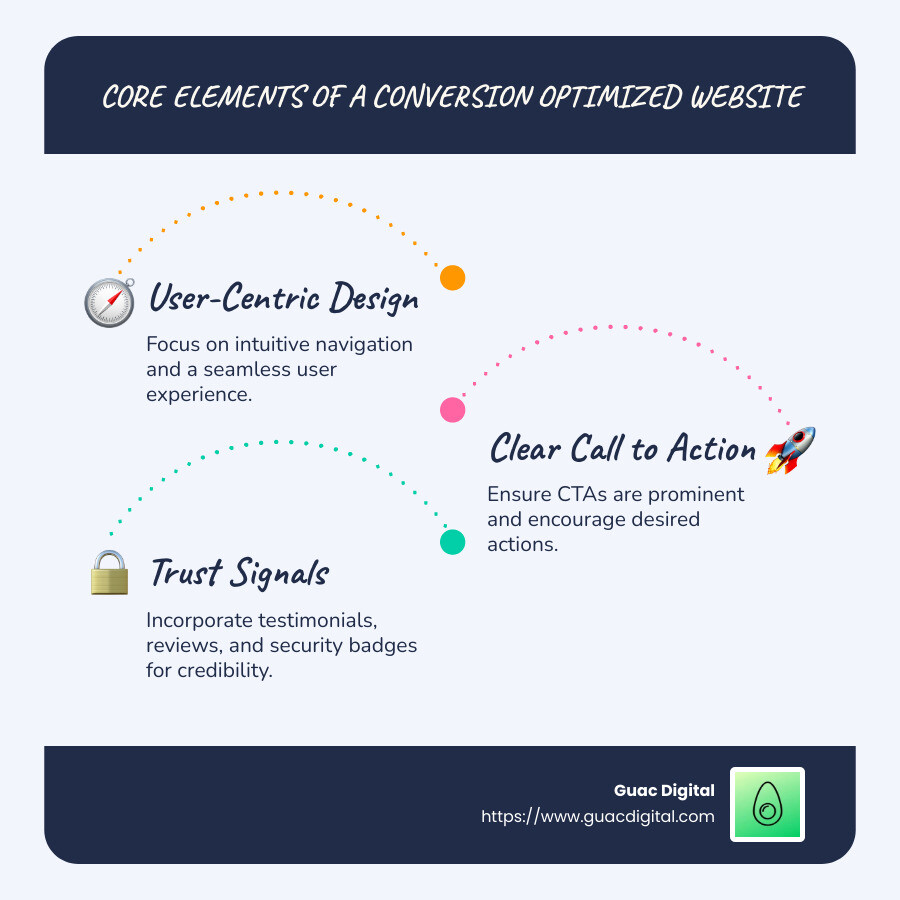
Here are key elements every conversion optimized website should have:
- User-Centric Design: Prioritize the user experience by making your website intuitive and easy to steer.
- Clear Call to Action (CTA): Ensure your CTAs are prominent and actionable.
- Trust Signals: Use testimonials, reviews, and security certifications to build visitor confidence.
- Compelling Content: Craft messages and visuals that resonate with your target audience.
- Responsive Design: Adapt to all devices, ensuring a seamless experience.
At Guac Digital, we understand that businesses face challenges with underperforming online campaigns and low brand visibility. Our user-centric approach to creating a conversion optimized website helps businesses improve their digital presence and capture opportunities effectively.
I’m Guy Leon, founder and CEO of Guac Digital. Over the years, we have significantly boosted client engagement through strategic digital marketing campaigns, particularly by optimizing client websites for conversions.
What is Conversion Rate Optimization (CRO)?
Conversion Rate Optimization (CRO) is the science and art of increasing the percentage of website visitors who complete a desired action. These actions can range from purchasing a product, signing up for a newsletter, or even just clicking on a link.
The core of CRO is understanding user behavior and making data-driven changes to boost conversions. It’s about making your website not just a digital presence but a dynamic tool that turns visitors into customers.
Desired Actions: The Heart of CRO
Every website has goals. These goals translate into desired actions that visitors should take. For e-commerce sites, it might be completing a purchase. For SaaS companies, it could be signing up for a free trial. Identifying these actions is the first step in crafting a conversion optimized website.
Pro Tip: Calculate your conversion rate by dividing the number of conversions by the total number of visitors, then multiply by 100. This gives you a percentage that reflects how well your site is achieving its goals.
Enhancing User Experience
A seamless user experience (UX) is crucial for CRO. Visitors should find your website intuitive and easy to steer. This means:
- Fast Load Times: Slow pages frustrate users and lead to drop-offs. Ensure your site loads quickly across all devices.
- Clear Pathways: Users should effortlessly find what they need without unnecessary clicks.
- Responsive Design: Your site should look and function well on any device, from desktops to smartphones.
Increasing Conversions Through Testing
Testing is at the heart of CRO. Techniques like A/B testing allow you to compare different versions of web pages to see which performs better. For instance, Optimizely and AB Tasty are popular tools that help refine these tests.
Example: Joe Geoghan from Optimizely tested two different book cover designs in emails. Contrary to expectations, the abstract version outperformed the real cover. This highlights the importance of testing assumptions and optimizing based on real data.
Continuous Improvement
CRO is not a one-time task. It requires ongoing analysis and iteration. Tools like Hotjar provide insights into user behavior and help identify areas for improvement. By constantly analyzing conversion funnels and user data, businesses can adapt and refine their strategies for better results.
Statistic: According to industry standards, a good conversion rate is typically between 2% and 5%. However, this varies by industry and business goals.
By focusing on these aspects, a conversion optimized website becomes a powerful asset in driving business growth and achieving digital marketing success.
Benefits of a Conversion Optimized Website
Creating a conversion optimized website offers numerous advantages that can significantly impact your business’s bottom line. Let’s explore some key benefits:
Lower Cost Per Acquisition (CPA)
One of the primary benefits of optimizing your website for conversions is a reduction in the cost per acquisition. When more visitors convert into customers, you spend less on marketing to achieve the same number of sales. As conversion rates increase, the efficiency of your marketing spend improves, leading to a better return on investment (ROI).
Example: By optimizing their landing pages, China Expat Health was able to increase their lead conversion rate by 79% simply by changing a headline. This small adjustment reduced their CPA and increased their marketing efficiency.
Greater Understanding of Customers
A conversion optimized website provides valuable insights into customer behavior. By analyzing how users interact with your site, you can better understand their needs and preferences. This knowledge allows you to tailor your offerings and improve the overall user experience.
Pro Tip: Use tools like Hotjar to gather user data and understand what motivates or hinders conversions. This can help in creating more targeted marketing strategies.
Competitive Advantage
In a crowded digital landscape, having a website that converts effectively gives you a competitive edge. It sets you apart from competitors who may not prioritize conversion rate optimization. A well-optimized site not only attracts more visitors but also retains them, increasing the likelihood of conversions.
Quote: “Without your audience’s trust, no conversion rate optimization strategies will work.” This highlights the importance of building trust through elements like reviews and testimonials, which can be a differentiator in competitive markets.
Increased Sales
The ultimate goal of a conversion optimized website is to boost sales. By guiding visitors smoothly through the sales funnel, you increase the chances of turning them into paying customers. This not only improves revenue but also contributes to business growth.
Statistic: Research shows that visitors interacting with reviews are 58% more likely to convert into paying customers. Incorporating social proof can be a powerful tool in driving sales.
Lower Effort Activity
Once a website is optimized for conversions, the ongoing effort to maintain high conversion rates is relatively low. Unlike constant marketing campaigns, a well-optimized site continues to perform effectively with minimal intervention. This allows businesses to focus on other growth areas while still reaping the benefits of their initial optimization efforts.
By understanding and leveraging these benefits, businesses can transform their websites into powerful tools for growth and success. Embracing conversion optimization not only improves customer experience but also drives tangible business results.

Next, we’ll dive into the Steps to Create a Conversion Optimized Website, where we’ll explore how to identify important conversions and analyze your conversion funnel.
Steps to Create a Conversion Optimized Website
Creating a conversion optimized website involves a systematic approach, starting with identifying key conversions and moving through analysis, data collection, hypothesis creation, testing, and iteration. Let’s break down each step:
Identify Important Conversions
First, determine what actions you want users to take on your website. These are known as conversions. For eCommerce sites, this might be a purchase. For SaaS companies, it could be a sign-up or subscription.
Calculate Conversion Rate: Use the formula: (Number of Conversions / Total Visitors) × 100. This helps in understanding how well your site is performing. For example, if you had 1000 visitors and 50 purchases, your conversion rate is 5%.
Analyze Your Conversion Funnel
A conversion funnel maps the journey visitors take from arriving at your site to completing a desired action. Analyzing this funnel helps you identify where users drop off.
Funnel Analysis: Use tools like Hotjar Funnels to visualize high-exit pages. This will show you where visitors lose interest and leave your site.
Gather User Data
Understanding user behavior is crucial. Identify what drives users to your site, what barriers they face, and what hooks them.
Hotjar Surveys: Use these to gather qualitative data directly from users. Ask questions like, “What stopped you from completing your purchase today?” to identify pain points.
User Personas: Develop personas to represent your target audience. This helps in tailoring your site to meet their needs and preferences.
Create Hypotheses
Based on the data gathered, develop hypotheses for improving conversions. A hypothesis should clearly state the problem, proposed solution, and expected outcome.
Example: “Adding a guest checkout option will reduce cart abandonment by 10%.”
Test Your Hypotheses
Conduct A/B testing to validate your hypotheses. This involves comparing two versions of a webpage to see which performs better.
Tools: Use Optimizely or AB Tasty for robust testing. Measure both quantitative (conversion rate) and qualitative (user feedback) metrics.
Review and Iterate
Monitor your conversion rate regularly using tools like Hotjar Dashboards. This helps in tracking improvements and identifying new areas for optimization.
Ongoing CRO Program: Conversion optimization is not a one-time task. Continuously review and refine your strategies to adapt to changing user behaviors and market trends.
By following these steps, you’ll be well on your way to creating a website that not only attracts visitors but also converts them into loyal customers. Next, we’ll explore the Top 20 Conversion Rate Optimization Tips to further improve your website’s performance.
Top 20 Conversion Rate Optimization Tips
Creating a conversion optimized website is an ongoing process. Here are 20 actionable tips to help you boost your conversion rates:
1. Define Goals
Before diving into optimization, clearly define what you want users to do on your site. Whether it’s making a purchase, signing up for a newsletter, or downloading a guide, having clear goals is crucial. This helps you measure success and tailor your strategies.
2. Collect Visitor Data
Rely on data, not assumptions. Use tools like Google Analytics to track user behavior, traffic sources, and bounce rates. This data provides insights into what works and what doesn’t.
3. Perform Competitor Analysis
Know your competition. Analyze their strengths and weaknesses to find opportunities for your site. Highlight your unique selling points to stand out.
4. Assess Conversion Funnel
Use web analytics tools to map out your conversion funnel. Identify high-exit pages where users drop off and focus on improving those areas.
5. Highlight Value Proposition
Make sure your value proposition is clear and compelling. It should instantly communicate why users should choose you over competitors.
6. Optimize Page Layouts
A cluttered page can overwhelm visitors. Simplify your layout to guide users smoothly through your site. Ensure that the design is consistent and intuitive.
7. Use Persuasive Sales Copy
Your copy should speak directly to your audience. Focus on benefits, not just features. Use clear, compelling headlines and address the reader directly.
8. Build Trust
Include customer reviews and testimonials. Social proof can significantly increase trust and encourage conversions.
9. Simplify Navigation
Ensure your site is easy to steer. Use a clear menu structure and intuitive search functionality to help users find what they need quickly.
10. Improve Load Time
A slow website can drive users away. Optimize images, leverage browser caching, and use a content delivery network (CDN) to improve speed.
11. Test Before Deployment
Before rolling out changes, conduct A/B testing to see what works best. Tools like Optimizely can help you compare different versions of your site.
12. Add Live Chat
Provide real-time support with live chat. This can help address user concerns instantly, leading to higher satisfaction and conversions.
13. Remove Distractions
Keep users focused on your conversion goals. Remove unnecessary elements that might distract them from taking action.
14. Optimize Forms
Simplify forms by reducing the number of fields. Use inline validation to help users correct errors easily.
15. Make CTAs Stand Out
Your call-to-action buttons should be prominent and enticing. Use contrasting colors and action-oriented text like “Buy Now” or “Get Started.”
16. Reduce Cart Abandonment
Tackle cart abandonment by offering guest checkout options and sending follow-up emails to encourage users to complete their purchase.
17. Understand Psychology
Incorporate psychological principles like scarcity and social proof to influence user behavior. Understanding what drives decisions can improve your strategies.
18. Include Multimedia
Use high-quality images and videos to engage users. Visual content can communicate your message more effectively than text alone.
19. Deliver Personalized Experiences
Tailor your website experience based on user behavior and preferences. Personalized content can significantly boost engagement and conversions.
20. Monitor and Iterate
Regularly review your conversion rates and make adjustments as needed. Optimization is an ongoing process, and staying proactive is key to success.
By implementing these tips, you’ll be well-equipped to create a website that not only attracts visitors but also turns them into loyal customers. Next, we’ll dive into the essential tools for conversion optimization.
Tools for Conversion Optimization
To create a conversion optimized website, you need the right tools to gather data, test changes, and analyze results. Here are some of the top tools that can help you maximize conversions:
Hotjar
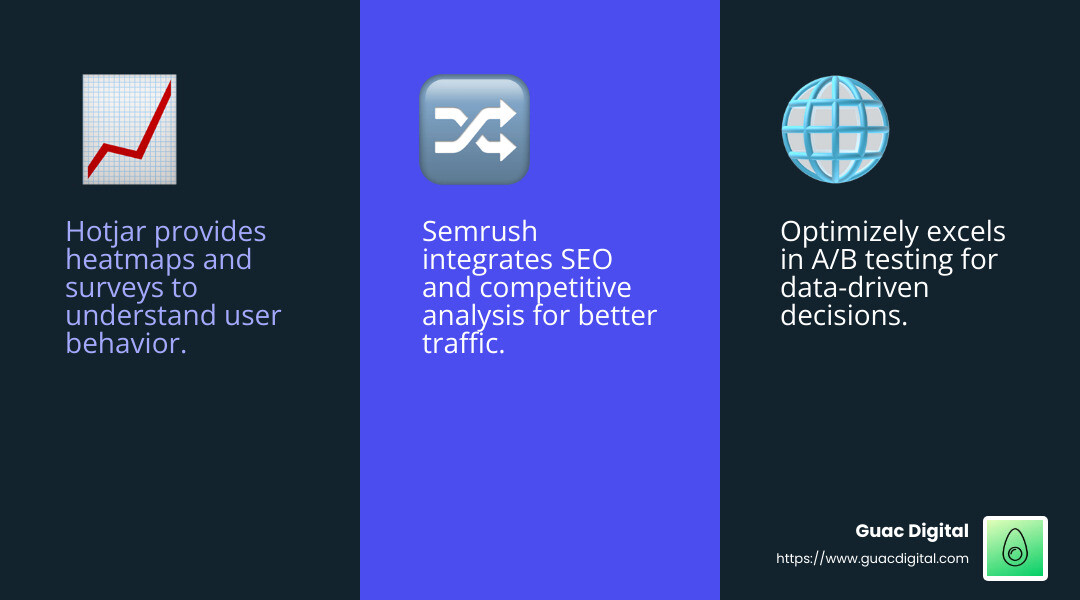
Hotjar is a powerful tool for understanding user behavior. It offers features like heatmaps, session recordings, and surveys. Heatmaps show where users click, move, and scroll on your site, helping you identify hot spots and areas for improvement. Surveys and feedback polls provide direct insights from your audience, allowing you to understand their needs and frustrations better.
Optimizely
Optimizely is a leading platform for A/B testing. It allows you to test different versions of your web pages to see which performs better. With Optimizely, you can experiment with headlines, layouts, CTAs, and more. This helps you make data-driven decisions and refine your website to boost conversions.
Semrush
Semrush is a comprehensive digital marketing tool that offers features for SEO, content marketing, and competitive analysis. It helps you identify high-performing keywords, analyze your competitors’ strategies, and optimize your content for search engines. By improving your SEO, you can drive more targeted traffic to your site, increasing the chances of conversion.
Plerdy
Plerdy provides a suite of tools for conversion rate optimization, including heatmaps, session recordings, and pop-up forms. Its heatmaps help you visualize user interactions, while pop-up forms can capture leads or offer special promotions. Plerdy also includes SEO-checker tools to ensure your site is optimized for search engines.
HelloBar
HelloBar specializes in creating attention-grabbing bars and pop-ups. These can be used to collect email addresses, promote special offers, or guide users to key pages. HelloBar integrates seamlessly with your website and can be customized to match your brand. By capturing user attention at the right moment, it helps increase engagement and conversions.
Using these tools, you can gather valuable insights and make informed decisions to improve your website’s performance. Each tool has its unique strengths, so consider your specific needs when choosing the right ones for your site.
In the next section, we’ll address some frequently asked questions about conversion optimized websites to further guide you on your journey.
Frequently Asked Questions about Conversion Optimized Websites
What is website conversion optimization?
Website conversion optimization is all about turning visitors into customers. It’s the process of making your website more effective at getting users to take specific actions, like signing up for a newsletter or making a purchase. By focusing on conversions, you ensure that every element of your site works towards increasing leads and sales.
How to optimize a website for conversions?
To optimize a website for conversions, start with a clear value proposition. This tells visitors why they should choose you over competitors. Use compelling headlines and persuasive copy to highlight benefits, not just features.
Pop-ups can be effective for capturing attention, but use them wisely. They should offer value, like a discount or newsletter signup, and not interrupt the user experience.
Urgency is a powerful motivator. Phrases like “limited time offer” can push users to act quickly.
Consider using third-party signups like Google or Facebook. These options make it easy for users to sign up without creating new accounts, reducing friction.
Your CTA (Call to Action) copy should be clear and direct. Use action words like “buy now” or “get started” to guide users.
Address customer concerns by providing detailed product information and clear pricing models. Transparency builds trust.
Finally, ensure your site is responsive. It should look great and function well on all devices. A mobile-friendly design is crucial as more users browse and shop on their phones.
What does optimized for conversions mean?
An optimized website is user-friendly and designed to guide visitors toward taking specific actions. This means providing relevant information that answers their questions and encourages click-throughs.
For example, if a user lands on your page looking for a product, they should easily find details, reviews, and a clear path to purchase. Every page should have a purpose and lead the user closer to conversion.
By focusing on these elements, you create a seamless journey for users, increasing the likelihood they’ll convert into customers.
In the next section, we’ll explore the various tools and strategies that can help you achieve a conversion optimized website.
Conclusion
At Guac Digital, we understand that creating a conversion optimized website is not just about tweaking a few elements. It’s about crafting a seamless user experience that guides visitors toward taking action. As a digital marketing agency based in Tampa, Florida, we specialize in designing personalized strategies that leverage big data for programmatic marketing, ensuring our clients achieve high ROI.
Our approach is rooted in understanding your unique business needs and tailoring our services to deliver the best results. By focusing on data-driven insights, we help businesses identify key opportunities for optimization and implement strategies that drive conversions. Whether it’s through A/B testing, user behavior analysis, or enhancing your website’s user interface, our goal is to make every visitor interaction count.
We believe that a successful digital presence requires more than just a beautiful website. It demands a site that is intuitive, engaging, and precisely aligned with your business goals. Our team at Guac Digital is committed to helping you transform your website into a powerful conversion tool that not only attracts visitors but also turns them into loyal customers.
Ready to take your website to the next level? Explore our services and find how we can help you achieve exceptional results with a custom digital strategy. Let’s work together to lift your online presence and master conversion optimization.