
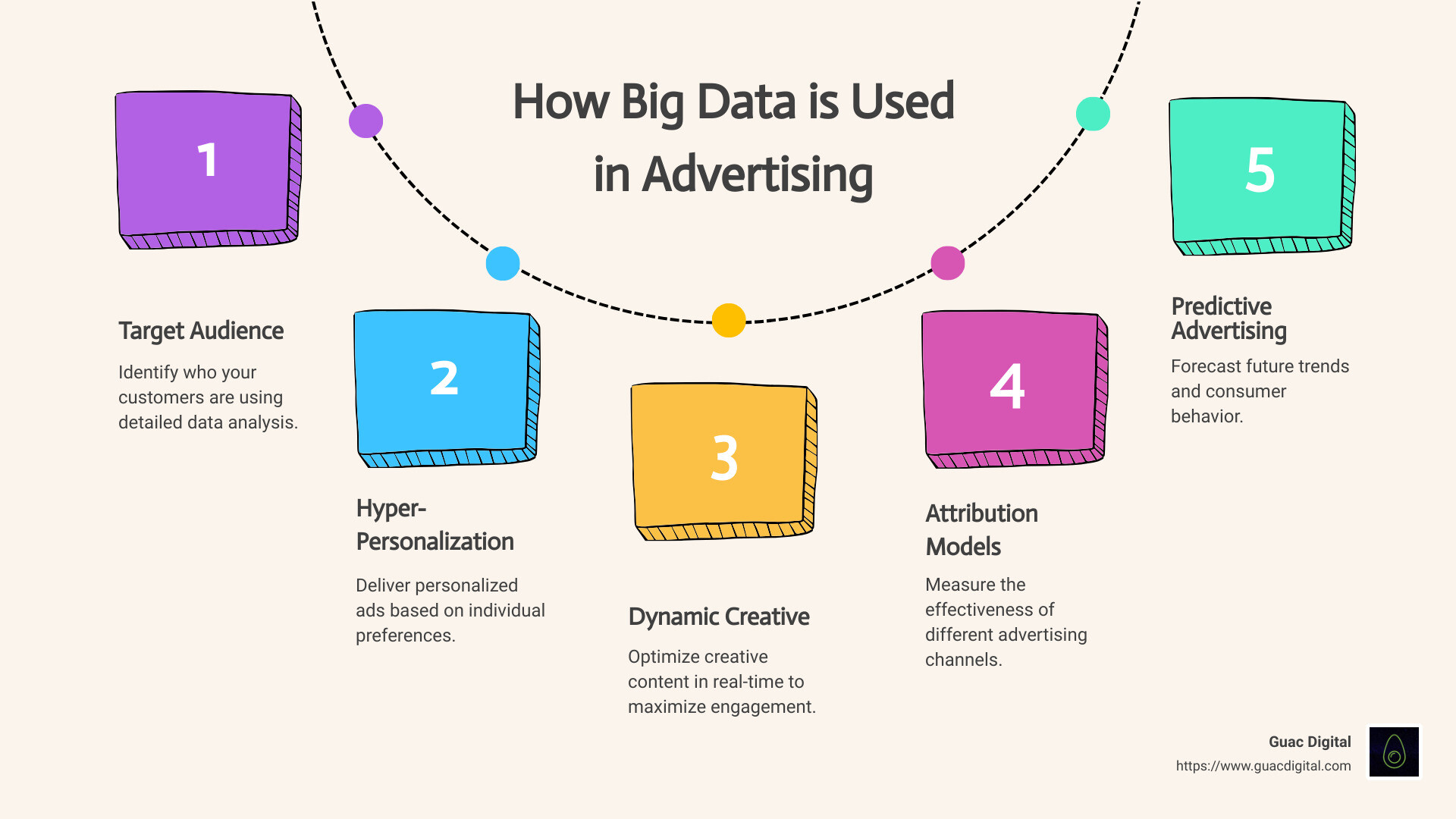
How is big data used in advertising? This comprehensive guide will solve the key ways big data transforms the advertising landscape:
- Target Audience Identification: Understand who your customers are, based on detailed data analysis.
- Hyper-Personalization: Deliver personalized ads custom to individual customer preferences.
- Dynamic Creative Optimization: Adjust your creative content in real-time to maximize engagement.
- Attribution Models: Track and measure the effectiveness of different advertising channels.
- Predictive Advertising: Forecast future trends and consumer behavior to stay ahead.
Big Data in advertising revolutionizes how businesses reach and engage with their audience. It offers deep insights, allowing marketers to craft precise and impactful campaigns. With advertising technology and digital marketing evolving rapidly, integrating Big Data is no longer optional—it’s essential.
Guy Leon, founder and CEO of Guac Digital, shares insights from his experience in the industry. With a proven track record of elevating client engagement and conversion rates by 350%, Guy knows how to harness the power of Big Data to optimize advertising strategies.
What is Big Data?
Big Data is a term that encompasses the large volumes of data generated every second from various sources like social media, online shopping, and even sensors in smart devices. This data is diverse and comes in different formats, making it a valuable resource for businesses.
Big Data is often described using the “3 Vs,” which stand for Volume, Velocity, and Variety. Let’s break these down:
Volume
The sheer amount of data generated is staggering. Think about all the tweets, Facebook posts, and online purchases made every second. This enormous amount of data is what we refer to as Volume.
For example, Facebook generates about 4 petabytes of data per day. That’s equivalent to about 4 million gigabytes!
Velocity
Velocity refers to the speed at which data is generated and processed. Data is created in real-time. Think of the constant flow of information from social media updates, online transactions, and GPS signals.
For instance, every minute, users upload more than 500 hours of video to YouTube. This rapid influx of data requires advanced systems to process and analyze it quickly.
Variety
Variety means the different types of data available. Data can be structured, like numbers and dates stored in databases, or unstructured, like emails, videos, and social media posts.
For example, a company might analyze customer reviews (text data) alongside sales numbers (numeric data) to get a complete picture of their performance.
Variability
Variability refers to the changing nature of data. For instance, data can vary greatly depending on the context or time. Social media trends can change rapidly, affecting how data should be interpreted.
Value
Finally, Value is about turning data into useful insights. Not all data is valuable, but with the right tools and analysis, businesses can extract meaningful information that drives decisions.
For instance, Netflix uses Big Data to recommend shows and movies custom to individual preferences, significantly enhancing user experience.

Big Data is not just about collecting large amounts of information. It’s about analyzing that data to uncover patterns and insights that can inform business decisions. This is particularly important in advertising, where understanding consumer behavior can lead to more effective and personalized marketing strategies.
By leveraging Big Data, advertisers can better understand their target audience, create hyper-personalized ads, and optimize their campaigns in real-time. This leads to higher engagement and better ROI.
In the next section, we’ll dive into how Big Data is used in advertising, focusing on smart segmentation, hyper-personalization, and more.
Big Data has revolutionized advertising by offering detailed insights and enabling more precise targeting. Here’s how:
Smart Segmentation
Segmentation means dividing your audience into smaller groups based on shared characteristics. Big Data allows for smart segmentation, making it more effective.
Behavioral Segmentation: Uses online behavior data like browsing habits, purchase history, and brand loyalty. For example, an online retailer might target frequent buyers with special offers.
Social-Demographic Segmentation: Focuses on age, gender, income, and education. An ad for luxury watches might target high-income males aged 30-50.
Geographic Segmentation: Targets people based on their location—country, city, or even neighborhood. A local restaurant might use this to attract nearby customers.
Psychographic Segmentation: Considers hobbies, lifestyle, and values. A fitness brand might target health-conscious individuals who value exercise and nutrition.
Dynamic Segmentation takes this further by using real-time data to update target groups continually. Tools like Guac Digital’s Advanced Segmentation facilitate this.
Hyper-Personalization
Big Data enables hyper-personalization, tailoring ads to individual preferences and behaviors.
Dynamic Creative: Shows different ads to different people based on criteria like gender, location, or browsing history. This ensures that each user sees the most relevant ad.
Creative Management Platform (CMP) and Dynamic Creative Optimization (DCO) tools help create and manage these personalized ads. Tools like Guac Digital’s Dynamic Ads are popular choices.
For instance, a travel company might show beach vacation ads to users who previously searched for tropical destinations, while showing ski vacation ads to others.

Attribution Models
Understanding which ads drive conversions is crucial. Attribution models help track this.
Data-Driven Attribution: Uses machine learning to analyze how different touchpoints contribute to conversions. Guac Digital’s Attribution Analytics is an example.
AIM Analytics: This platform helps track the performance of radio and TV ads, providing detailed insights to optimize future campaigns.
Predictive Advertising
Predictive Advertising leverages historical data and machine learning to forecast future behaviors.
Predictive Analysis: Uses past data to predict future trends. This can help in identifying look-alike audiences who are likely to convert.
Predictive Bidding: Adjusts bids in real-time based on predicted ad performance, optimizing ad spend.
Retargeting: Uses predictive models to show ads to users who are most likely to convert based on their past behavior.
Companies like Guac Digital’s Predictive Solutions offer advanced predictive advertising solutions.
By using Big Data for smart segmentation, hyper-personalization, attribution models, and predictive advertising, businesses can create more effective, targeted, and profitable ad campaigns. This not only improves ROI but also improves the user experience by showing relevant ads.
In the next section, we’ll explore the benefits of using Big Data in advertising, including customer insights and campaign optimization.
Benefits of Using Big Data in Advertising
Customer Insights
Big Data offers a treasure trove of customer insights that can transform your advertising strategy. By analyzing user demographics, preferences, and behavior patterns, advertisers can create highly personalized marketing campaigns.
For instance, if you know that a segment of your audience prefers eco-friendly products, you can tailor your ads to highlight the sustainable aspects of your offerings. This not only increases engagement but also builds customer loyalty.
Campaign Optimization
Effective campaign optimization is another significant benefit of Big Data. With real-time data, advertisers can monitor ad performance and adjust strategies on the fly. This ensures that resources are allocated efficiently, maximizing ROI.
Imagine launching a new product and seeing immediate feedback on social media. If the response is positive, you can increase your ad spend to capitalize on the momentum. Conversely, if the feedback is negative, you can pivot your strategy quickly to mitigate any damage.
Cost Reduction
One of the most compelling advantages of Big Data is cost reduction. By enabling efficient ad spend and improved targeting, Big Data minimizes waste. Advertisers can focus their budgets on high-performing campaigns and cut back on those that aren’t delivering results.
For example, predictive analytics can identify which segments of your audience are most likely to convert, allowing you to allocate your budget more effectively. This not only saves money but also boosts the overall effectiveness of your campaigns.
Competitive Advantage
Finally, Big Data provides a significant competitive advantage. By analyzing market trends and conducting competitor analysis, businesses can make informed strategic decisions.
Consider a scenario where your competitor launches a new product. By monitoring social media and other data sources, you can gauge public reaction and adjust your own strategies accordingly. This proactive approach keeps you ahead of the competition and better aligned with consumer needs.
In summary, Big Data is a game-changer in advertising, offering deep customer insights, optimized campaigns, cost savings, and a competitive edge. By leveraging these benefits, businesses can create more effective and targeted advertising strategies.
Next, we’ll dig into the challenges of using Big Data in advertising, including data privacy and security concerns.
Challenges in Using Big Data for Advertising
While Big Data offers numerous benefits, it also comes with its own set of challenges. Let’s explore the most significant problems: data privacy, data security, infrastructure costs, and talent requirements.
Data Privacy
Consumer trust is paramount in today’s digital landscape. People are increasingly aware of how their data is collected and used. They want personalized experiences but not at the expense of their privacy. Balancing data personalization with privacy concerns is a tightrope walk.
Privacy balance is crucial. Companies must be transparent about data usage and ensure compliance with regulations like the GDPR. Failure to do so can result in hefty fines and loss of consumer trust.
Data Security
Data security is another critical issue. With the rise in data breaches, companies need to implement robust security measures. Techniques like cryptography, access control, and data backups are essential.
Intrusion detection systems can help identify and prevent unauthorized access. According to Forbes, prioritizing security can promote privacy, ensuring that consumer data remains safe and secure.
Infrastructure Costs
Big Data requires substantial infrastructure costs. The need for extensive data storage, processing power, and advanced analytics tools can be expensive.
Using cloud services like Amazon Web Services, Microsoft Azure, and Google Cloud can help manage these costs. However, companies must still monitor usage to prevent expenses from spiraling out of control.
Talent Requirements
Finally, the demand for skilled professionals is high. Companies need data scientists, analysts, and technical experts to manage and interpret Big Data effectively.
Balancing expertise against automation is key. While technology can handle much of the heavy lifting, human insight is crucial for constructing successful prediction and decision-making models. As Forbes notes, well-trained data scientists with deep domain knowledge are invaluable.
In summary, while Big Data offers transformative potential in advertising, companies must steer challenges related to data privacy, security, infrastructure costs, and talent requirements. Next, we’ll answer some frequently asked questions about Big Data in advertising.
Frequently Asked Questions about Big Data in Advertising
How is big data used in targeted advertising?
Big data is a game-changer in targeted advertising. By gathering and analyzing vast amounts of data, advertisers can pinpoint their target demographic with incredible precision. This involves looking at engagement patterns, such as how users interact with ads, what they click on, and how long they stay on a page.
For instance, personalized ads are made possible by big data. If a user frequently searches for hiking gear, they might start seeing ads for outdoor equipment. This isn’t random; it’s based on their behavior and preferences.
How do companies use big data in marketing?
Companies use big data to get a comprehensive user base snapshot. This means understanding who their customers are, what they like, and how they behave online. By analyzing trends, preferences, and behavior patterns, companies can tailor their marketing strategies to better meet customer needs.
For example, big data can reveal that a particular product is popular among millennials in urban areas. This insight allows companies to create targeted campaigns that resonate with this specific group, improving engagement and sales.
How is big data used in media?
In the media industry, big data plays a crucial role in audience analytics. Media companies can track which articles are read the most, what topics are trending, and how long readers stay engaged with content. This helps in crafting more compelling stories that capture audience interest.
Journalistic storytelling is also improved by big data. By analyzing data, journalists can uncover hidden trends and present stories that are not only engaging but also backed by solid data.
Additionally, big data is vital in video management. Platforms like YouTube and Netflix use it to recommend videos based on user preferences and viewing history. This ensures that users are more likely to find content they enjoy, keeping them engaged longer.
Big data is revolutionizing advertising and media by providing deep insights into user behavior and preferences. This allows for more targeted, personalized, and effective marketing strategies.
Conclusion
At Guac Digital, we are excited about leveraging big data to transform your advertising strategies. Big data allows us to dive deep into user insights, enabling us to create hyper-personalized campaigns that resonate with your audience.
By embracing programmatic marketing, we automate the buying of ad space, ensuring your ads appear in front of the right people at the right time. This automation not only saves time but also improves targeting accuracy, leading to higher engagement rates.
Our expertise in big data allows us to deliver high ROI for our clients. We use advanced analytics to continuously monitor and optimize your campaigns, ensuring every dollar spent is working hard for you. This means more efficient ad spend and reduced waste, ultimately driving better results for your business.
We also focus on creating personalized strategies that align with your brand’s goals. Whether it’s through dynamic creative optimization or smart segmentation, we tailor our approach to meet your specific needs. This ensures that your message is not only seen but also remembered by your target audience.
Ready to lift your advertising game with the power of big data? Contact Guac Digital today and let’s create campaigns that drive real results.