
Understanding How Marketing Agencies Make Money
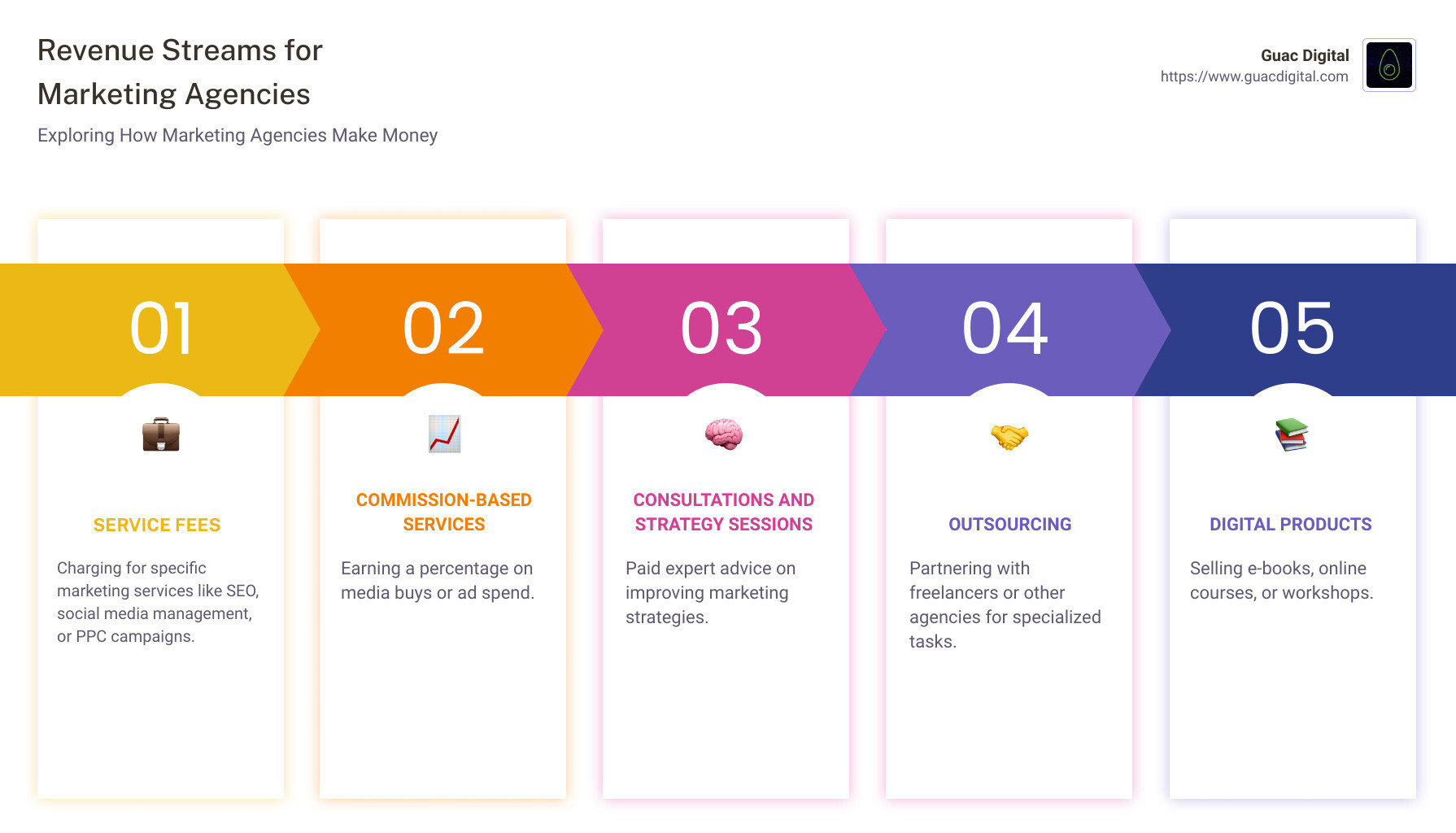
How do marketing agencies make money? It’s a question many businesses wonder about when exploring ways to boost their online presence. Here are the primary methods:
- Service Fees: Charging for specific marketing services like SEO, social media management, or PPC campaigns.
- Commission-Based Services: Earning a percentage on media buys or ad spend.
- Consultations and Strategy Sessions: Paid expert advice on improving marketing strategies.
- Outsourcing: Partnering with freelancers or other agencies for specialized tasks.
- Digital Products: Selling e-books, online courses, or workshops.
In today’s fast-evolving digital landscape, marketing agencies have adapted from simple SEO and email campaigns to complex, multi-channel strategies. This shift has created diverse revenue streams, allowing agencies to optimize their profitability while offering custom solutions to clients.
I’m Guy Leon, founder and CEO of Guac Digital, and I’ve spent years helping businesses like yours increase engagement and traffic through efficient marketing strategies. With a diverse range of income streams, we ensure sustainable growth and long-term success for both our agency and our clients.
Let’s dive deeper into the core services and revenue models that make marketing agencies thrive.
Core Services Offered by Marketing Agencies
Marketing agencies offer a variety of services to help businesses grow. Here are some of the key services they provide:
SEO (Search Engine Optimization)
SEO is about improving your website’s visibility on search engines like Google. This involves:
- Keyword Research: Finding the right words people use to search for your products.
- On-Page SEO: Optimizing your website content and structure.
- Off-Page SEO: Building backlinks from other websites to improve your site’s authority.
Example: By using effective SEO strategies, a client might see a 50% increase in organic traffic within six months.
Content Marketing
Content marketing focuses on creating valuable content to attract and engage your audience. This can include:
- Blog Posts: Informative articles related to your industry.
- Videos: Engaging video content that tells your brand’s story.
- E-books and Whitepapers: In-depth guides that provide value to your audience.
Statistic: Companies that use content marketing see six times higher conversion rates than those that don’t .
Social Media Marketing
Social media marketing involves promoting your brand on platforms like Facebook, Instagram, and Twitter. This includes:
- Content Creation: Developing posts, images, and videos.
- Community Management: Engaging with followers and responding to comments.
- Paid Social Ads: Running targeted ad campaigns to reach specific demographics.
Case Study: A brand might see a 30% increase in followers and a 20% boost in sales after a well-executed social media campaign.
Email Marketing
Email marketing is a powerful way to reach your audience directly. This involves:
- Newsletter Campaigns: Regular updates sent to your email list.
- Automated Emails: Triggered emails based on user behavior, like welcome emails or abandoned cart reminders.
- Personalization: Tailoring email content to individual preferences.
Fact: Email marketing has an average ROI of $42 for every $1 spent (source).
Influencer Marketing
Influencer marketing leverages popular social media personalities to promote your brand. This includes:
- Partnerships: Collaborating with influencers who align with your brand.
- Sponsored Content: Paying influencers to create content featuring your products.
- Campaign Management: Monitoring and measuring the impact of influencer campaigns.
Statistic: 89% of marketers say ROI from influencer marketing is comparable to or better than other marketing channels (source).
Paid Ads
Paid advertising involves paying for ad placements on platforms like Google, Facebook, and Instagram. This includes:
- PPC (Pay-Per-Click): Paying each time someone clicks on your ad.
- Display Ads: Banner ads on various websites.
- Retargeting: Showing ads to people who have visited your site before.
Example: A client might allocate $10,000 monthly on Facebook ads, leading to a significant increase in site traffic and conversions.
Outdoor Marketing
Outdoor marketing uses physical spaces to promote your brand. This can include:
- Billboards: Large ads placed in high-traffic areas.
- Transit Ads: Ads on buses, trains, and subways.
- Event Sponsorships: Promoting your brand at local events or festivals.
Fact: Outdoor ads can reach 96% of consumers in major markets weekly (source).
These core services help marketing agencies create comprehensive strategies that drive growth and success for their clients.
Next, let’s explore how marketing agencies make money through various revenue models and pricing strategies.
How Do Marketing Agencies Make Money
Marketing agencies use a variety of revenue models and pricing strategies to make money. Let’s break down how they do it.
Digital Marketing Services
Agencies offer core services such as SEO, social media marketing, content creation, and online advertising.
- SEO Services: Agencies improve clients’ search engine rankings. They charge based on deliverables (like keyword research and link building) or through monthly retainers.
- Social Media Marketing: Agencies manage social media campaigns. This can be priced hourly, per post, or through monthly packages.
- Content Creation: Creating blogs, videos, and graphics. Pricing can be per piece or as part of a retainer.
- Online Advertising: Managing ad campaigns on platforms like Google Ads or Facebook. Agencies might use a percentage of ad spend or a flat fee.
Commission-Based Services
Agencies often buy media (like ad space) on behalf of clients.
- Media Buying: Agencies purchase ad space and mark up the cost. For instance, if ad space costs $1 per click, the agency might charge the client $1.20 per click, keeping the $0.20 as commission.
- Transparency: Clients expect clear breakdowns of costs. Agencies need to show how much is spent on media versus their fees to maintain trust.
Paid Consultations
Agencies also make money from paid consultations.
- Expert Advice: Offering one-time strategy sessions.
- Strategy Calls: These can convert into long-term contracts.
- Scheduling Tools: Tools like Calendly help manage appointments, making the process smooth for both parties.
Outsourcing Work
Many agencies outsource work to freelancers and contractors.
- Freelancers and Contractors: Agencies might outsource content creation, website development, or graphic design.
- Cost-Effective: This allows agencies to offer a wide range of services without hiring full-time staff.
Client Referrals
Client referrals are vital for growth.
- Reputation: Happy clients refer others, which reduces acquisition costs.
- Referral Programs: Agencies can set up programs where clients get rewards for referrals.
Digital Assets
Agencies can create and sell digital assets for passive income.
- E-books and Online Courses: Offering in-depth knowledge on industry topics.
- Webinars and Workshops: Hosting educational sessions.
- Passive Income: These assets generate ongoing revenue with minimal upkeep.
SaaS Products
Developing SaaS products can be lucrative.
- Automation Tools: Creating tools that help clients automate marketing tasks.
- Subscription Models: Charging clients a monthly fee for access.
- Market Gap: Identifying unmet needs in the market to create high-demand products.
Affiliate Marketing
Agencies can earn through affiliate marketing.
- Commissions: Partnering with third-party publishers to promote products and earning a commission on sales.
- Transparency: Clear communication about commissions builds trust with clients.
Partnering with Other Agencies
Partnering with other agencies can expand service offerings.
- Resource Sharing: Agencies can share resources to tackle larger projects.
- White Labeling: Providing services under another agency’s brand.
- Joint Ventures: Collaborating on projects for mutual benefit.
Equity Deals
Some agencies enter equity deals with clients.
- Ownership Stakes: Taking a percentage of the client’s company in exchange for services.
- Long-Term Partnerships: This aligns the agency’s success with the client’s growth.
- Due Diligence: Careful assessment is crucial to ensure financial upside.
Hosting Events
Agencies can also host industry events.
- Brand Exposure: Events boost the agency’s profile.
- Lead Generation: Attracting potential clients.
- Sponsorships: Securing sponsors for additional revenue.
By leveraging these diverse revenue streams, marketing agencies can maintain financial health and grow their business. Next, we’ll dive into the frequently asked questions about how marketing agencies make money.
Frequently Asked Questions about How Marketing Agencies Make Money
How profitable is a marketing agency?
Marketing agency profitability varies widely. Profit margins can range from 10% to 30%, depending on the agency’s efficiency and niche. Agencies that specialize in high-demand services like SEO, PPC, and social media management often see higher margins.
According to Marcel Petitpas, founder of Parakeeto, a 20% EBITDA after paying market-rate salaries is a good benchmark. Financial goals should focus on balancing business costs with fee structures to achieve sustainable growth.
How are marketing agencies paid?
Marketing agencies use different pricing models to get paid:
- Hourly Rates: Agencies charge clients based on the number of hours worked. This model offers transparency but can become costly if projects take longer than expected.
- Commission-Based Pricing: Typically used in media buying, agencies take a percentage of the media spend. This can range from 6% to 15%.
- Fixed-Price Models: Clients pay a set fee for specific deliverables or projects. This provides clarity on costs but requires precise project scoping.
- Value-Based Pricing: Charges are based on the value the agency delivers to the client’s business. This often involves higher fees if the agency’s work significantly boosts the client’s revenue.
How do agencies earn money?
Agencies use various fee structures and project-based fees to earn money:
- Retainer-Based Fees: Clients pay a fixed monthly fee for ongoing services. This ensures steady income and ongoing support for clients.
- Project-Based Fees: Agencies charge for specific projects like website development or a marketing campaign. This model is flexible but requires careful project management to avoid scope creep.
- Value-Based Pricing: Agencies charge based on the impact of their work on the client’s business. For example, if a campaign significantly increases sales, the agency might charge a premium.
Understanding these models helps agencies choose the best approach for their business and client needs, ensuring a win-win for both parties.
Conclusion
At Guac Digital, we understand that diversifying income channels is crucial for long-term stability and growth. By offering a variety of services, from SEO and content marketing to paid consultations and digital assets, we ensure that our revenue streams are both robust and resilient.
Diversified Income Channels
Our approach includes commission-based services, paid consultations, and digital products like e-books and online courses. These diversified income channels not only help us mitigate risk but also enable us to provide comprehensive solutions to our clients.
Long-Term Stability
By focusing on long-term partnerships and offering ongoing support, we build relationships that stand the test of time. Our commitment to transparency and value-based pricing ensures that our clients know exactly what they’re paying for and the impact it has on their business.
Growth Strategies
We continuously explore new avenues for growth, such as developing SaaS products and entering affiliate programs. These strategies not only offer high potential ROI but also keep us at the cutting edge of digital marketing.
For more information on our services and how we can help your business grow, visit our services page.
By diversifying our revenue streams and focusing on sustainable growth strategies, Guac Digital is well-positioned to thrive in the changing digital marketing landscape.