
What Social Media Management Agency Services Can Do for Your Brand in 2026
Quick Answer
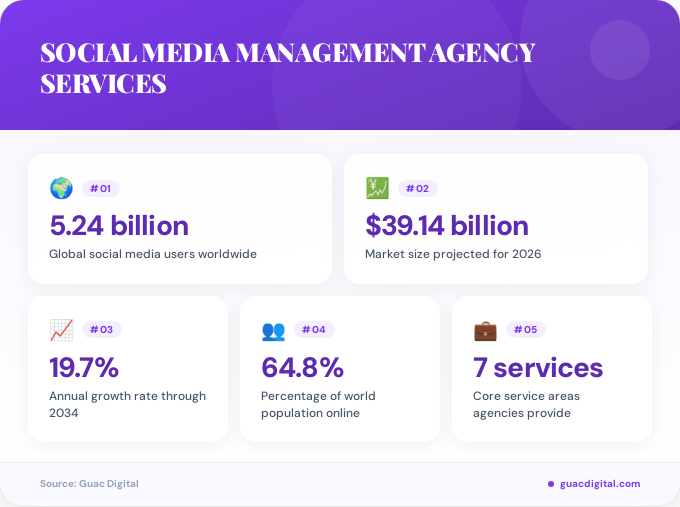
Social media management agency services encompass strategy development, content creation, publishing, community management, paid advertising, analytics, and influencer partnerships that help brands build and maintain their social presence. The global market for these services is projected to reach $39.14 billion in 2026 and grow at 19.7% annually through 2034, with agencies increasingly hired for strategic growth rather than just content posting.
In 2026, brands are facing a social media landscape more complex and opportunity-rich than ever before. With 5.24 billion people actively using social platforms globally, representing 64.8% of the world’s population, the question isn’t whether your brand should be on social media. The question is whether you can afford to manage it without expert help.
Professional social media agencies have evolved far beyond simple posting services. Today’s social media management agency services combine creative storytelling, data science, paid media expertise, and real-time community engagement into integrated programs that drive measurable business growth.
The numbers tell a compelling story. According to Fortune Business Insights, the global social media management market is expected to grow from $39.14 billion in 2026 to $164.52 billion by 2034, a compound annual growth rate of nearly 20%. This explosive growth reflects both rising platform usage and the increasing sophistication of services brands need to compete effectively.
What Are Social Media Management Agency Services?
Social media management agency services are comprehensive professional offerings that handle every aspect of a brand’s social media presence. These services go far beyond creating and scheduling posts, encompassing strategy development, audience research, creative production, community engagement, paid advertising, analytics, and ongoing optimization.
At their core, these agencies serve as an extension of your marketing team, bringing specialized expertise in platform algorithms, content trends, advertising systems, and data analysis that most in-house teams lack. They combine creative and technical capabilities to build social programs that achieve specific business objectives, whether that’s brand awareness, lead generation, e-commerce sales, or customer retention.
What distinguishes professional agency services in 2026 is the strategic depth. Modern agencies aren’t order-takers who simply execute your content ideas. They’re strategic partners who conduct competitive research, identify untapped audience segments, develop differentiated positioning, and build testing frameworks that continuously improve performance over time.
What Do Social Media Management Agency Services Actually Do?
Understanding what agencies deliver helps brands evaluate potential partners and set appropriate expectations. Here’s a detailed breakdown of the core service areas most agencies provide as part of comprehensive social media marketing programs.
Strategy and Channel Planning
Every effective social program starts with strategic planning. Agencies conduct audience research to understand who your customers are, where they spend time online, what content they engage with, and what messaging resonates. This research informs platform selection, ensuring resources focus on channels that actually reach your target market.
Strategic planning also includes defining content pillars (the core topics your brand will address), establishing posting cadence, planning campaign calendars around product launches or seasonal moments, and setting measurable KPIs that tie social activity to business outcomes.
Content Creation and Production
Content is the fuel of social media, and agencies typically handle all creative production. In 2026, this means primarily short-form video, which dominates engagement across platforms. Agencies produce Instagram Reels, TikTok videos, YouTube Shorts, and platform-specific formats, along with static graphics, carousel posts, and written captions.
High-performing agencies maintain brand consistency through templated designs, style guides, and approval workflows while still creating content that feels native to each platform. They also stay current with trending formats, audio, and creative techniques that drive organic reach.
Publishing and Account Management
Agencies handle the operational work of maintaining active social accounts. This includes scheduling posts at optimal times, coordinating multi-platform calendars, managing content libraries, and ensuring consistent brand voice across all touchpoints.
Account management also covers technical maintenance like updating profile information, managing linked accounts, coordinating with platform representatives for verification or support, and staying compliant with platform policies that constantly evolve.
Community Management and Engagement
One of the most time-intensive yet valuable services is community management, which is the practice of responding to comments, direct messages, mentions, and questions in real-time. According to Sprout Social’s research, response speed and personalization are now central to brand perception, with audiences expecting replies within hours, not days.
Skilled community managers don’t just respond reactively. They proactively engage with relevant conversations, participate in trending topics when appropriate, build relationships with brand advocates, and escalate customer service issues before they become public relations problems.
Paid Social Advertising
Organic reach continues to decline across major platforms, making paid advertising essential for most brands. Agencies manage end-to-end paid social programs, including campaign strategy, audience targeting, creative development, budget allocation, conversion tracking setup, and ongoing optimization.
With global social ad spend projected at approximately $276 billion in 2026, according to Digital Applied, the competition for attention is fierce. Professional agencies bring testing methodologies, platform expertise, and analytical rigor that dramatically improve return on ad spend.
Analytics and Performance Reporting
Data analysis separates high-performing programs from busy work. Agencies track KPIs like reach, engagement rate, follower growth, website traffic, lead generation, and revenue attribution. They build dashboards that make performance visible and provide regular reports with actionable recommendations.
Beyond surface metrics, sophisticated agencies conduct deeper analysis: which content formats drive the most engagement, which audience segments convert best, which posting times maximize reach, and how social performance compares to competitors in your industry.
Influencer and Creator Partnerships
Influencer marketing has matured from a fringe tactic to a core component of many social strategies. Agencies increasingly bundle creator identification, outreach, contract negotiation, campaign coordination, and performance tracking into their service offerings, especially for brands targeting younger demographics who trust creator recommendations over traditional advertising.

How Big Is the Social Media Management Market in 2026?
The market for social media management agency services has reached unprecedented scale, driven by platform growth, increased usage, and rising sophistication of both organic and paid tactics. Understanding market size helps contextualize the investment brands are making and the competitive landscape agencies navigate.
| Metric | 2026 Value | Future Projection |
|---|---|---|
| Global Market Size | $39.14 billion | $164.52B by 2034 (19.7% CAGR) |
| North America Share | 39.3% of global market | Continued leadership expected |
| Global Social Users | 5.24 billion (64.8% of population) | 6.05B projected by 2028 |
| Global Ad Spend | $276 billion | Continued double-digit growth |
North America held 39.3% of the global market share in 2025, underscoring the region’s continued dominance in social media marketing investment. This concentration reflects higher digital maturity, greater advertising budgets, and more competitive landscapes that necessitate professional management.
The projected growth to $164.52 billion by 2034 represents nearly a fourfold increase in just eight years. This expansion reflects several factors: more businesses recognizing social media as essential rather than optional, increasing complexity requiring specialized expertise, platform proliferation creating management challenges, and the proven ROI of professional services justifying higher investment.
For brands evaluating whether to bring social media management services in-house or partner with an agency, this market growth signals that professional expertise delivers measurable value. The industry wouldn’t be expanding at nearly 20% annually if agencies weren’t consistently proving ROI.
Which Platforms Are Agencies Managing in 2026?
Platform selection significantly impacts social strategy, and agencies help brands navigate an increasingly fragmented landscape. While Facebook remains the largest platform with approximately 3.1 billion monthly active users, the optimal platform mix varies by industry, audience demographics, and business objectives.
Instagram continues its strength with younger audiences and visual brands, particularly through Reels and Stories. TikTok has cemented its position as a must-have platform for reaching Gen Z and increasingly Millennials, with its short-form video format influencing content approaches across all platforms.
LinkedIn has matured beyond recruitment into a powerful B2B marketing channel, especially for thought leadership and demand generation. YouTube maintains its position as the second-largest search engine and the dominant long-form video platform, while newer platforms like Threads are carving out niches in real-time conversation.
“The average person now spends 2 hours and 28 minutes per day on social media platforms, making social presence not just beneficial but essential for brands seeking to reach their audiences where they’re already spending time.”
Agencies typically recommend a focused platform strategy rather than trying to maintain presence everywhere. A B2B software company might concentrate on LinkedIn, YouTube, and Twitter, while a fashion brand might prioritize Instagram, TikTok, and Pinterest. The key is aligning platform selection with where your specific audience spends time and what content formats fit your brand strengths.
What ROI Can Brands Expect from Social Media Management Agency Services?
Return on investment is the ultimate measure of agency value, and 2026 data demonstrates that professional social media management agency services deliver quantifiable returns across multiple business objectives. Understanding typical ROI helps set realistic expectations and build appropriate measurement frameworks.
According to recent marketing analysis, social media marketing delivers an average $5.20 in ROI per $1 spent. This 520% return makes social media one of the highest-performing marketing channels when managed strategically. However, this average masks significant variation based on industry, platform mix, content quality, and whether organic and paid tactics are integrated effectively.
The ROI of agency services extends beyond direct revenue attribution. Professional management delivers value through brand awareness (reaching new audiences at scale), community building (creating loyal customer bases that drive repeat purchases), customer service (resolving issues publicly and building trust), competitive intelligence (monitoring competitor activity and identifying opportunities), and content efficiency (producing more effective creative faster than in-house teams).
Social commerce represents an increasingly significant ROI channel. With platforms like Instagram and TikTok integrating native shopping features, the social commerce market reached an estimated $1.09 trillion in 2026. Agencies that understand platform-specific commerce features and optimize the full funnel from discovery to purchase drive measurably higher returns.
When evaluating social media marketing ROI, the most sophisticated brands look beyond last-click attribution. They measure assisted conversions (social touchpoints in multi-channel customer journeys), brand lift (changes in awareness and consideration), customer lifetime value (how social-acquired customers perform over time), and opportunity cost (what you’d lose by not maintaining competitive social presence).
How Much Do Social Media Management Agency Services Cost?
Investment in social media management agency services varies widely based on scope, platforms managed, content volume, paid media budget, industry complexity, and agency expertise. Pricing ranges from $3,000 to $50,000+ per month, with enterprise brands often investing significantly more for comprehensive programs across multiple markets and languages.
Several factors influence pricing. Small businesses seeking basic management of 1-2 platforms with limited content creation might invest toward the lower end of the range. Mid-market companies wanting multi-platform management, regular content production, community management, and basic paid advertising typically invest $8,000 to $20,000 monthly. Enterprise brands requiring strategic consulting, extensive creative production, large paid budgets, influencer programs, and dedicated account teams often invest $25,000 to $100,000+ monthly.
Pricing models vary by agency. Monthly retainers provide predictable costs and ongoing partnership, typically including strategy, content creation, publishing, community management, and reporting. Project-based pricing works for defined initiatives like campaign launches or seasonal programs. Performance-based models tie some fees to results like follower growth, engagement metrics, or conversion goals, though these are less common for organic social.
Paid advertising typically operates on a separate budget, with agencies either charging management fees (commonly 10-20% of ad spend) or including ad management in monthly retainers up to specified spend levels. Media budget requirements vary tremendously: local businesses might spend $1,000 to $5,000 monthly, while national brands often invest $50,000 to $500,000+ monthly on paid social.
When evaluating pricing, consider what’s included. Does the proposal cover strategy development, or just execution? How many pieces of content are produced monthly? Is community management included or extra? Are analytics and reporting comprehensive or basic? What level of account team do you get? Pricing varies based on your specific project scope, industry, and business objectives, so it’s worth contacting agencies for custom quotes rather than making decisions based on generic ranges.
The value proposition of professional services becomes clear when comparing alternatives. Hiring in-house social media managers, content creators, graphic designers, videographers, paid media specialists, and analysts to match agency capabilities typically costs significantly more than agency fees, while lacking the platform expertise and cross-client learning agencies bring.
How Do You Choose the Right Social Media Management Agency?
Selecting the right agency partner is one of the most important marketing decisions brands make, as your agency becomes the voice and face of your brand across platforms reaching billions of people. Several evaluation criteria help identify agencies capable of delivering results.
Relevant Industry Experience
While creativity translates across industries, understanding your specific market matters. B2B agencies understand LinkedIn strategy and thought leadership content. E-commerce agencies excel at conversion-focused content and social commerce. Local service businesses benefit from agencies experienced in geo-targeted campaigns and reputation management.
Review case studies and client lists to assess whether agencies have successfully served brands similar to yours. Ask specific questions about challenges they’ve navigated in your industry and results they’ve achieved.
Platform Expertise and Certifications
Platform expertise separates competent agencies from exceptional ones. Look for official partner status with major platforms (Facebook/Meta Business Partners, TikTok Marketing Partners, YouTube Certified, LinkedIn Marketing Partners). These certifications indicate advanced training, proven results, and often early access to new features.
Ask agencies which platforms they specialize in and request examples of recent campaigns on those platforms. An agency claiming equal expertise across ten platforms likely lacks deep specialization.
Creative Capabilities and Production Quality
Review the agency’s own social presence and client content portfolios. Is the creative on-brand and scroll-stopping? Do they demonstrate range across content formats? Can they produce platform-native video, not just repurposed brand videos? Is the production quality consistent with your brand standards?
Request to see content calendars, creative briefs, and approval workflows to understand their production process. Agencies with robust creative operations deliver more consistently than those treating content as an afterthought.
Analytics and Reporting Approach
Data-driven agencies distinguish themselves through sophisticated measurement. Ask to see sample reports, dashboards, and KPI frameworks. Do they track vanity metrics (followers, likes) or business metrics (conversions, revenue, customer acquisition cost)? Can they demonstrate how they’ve used data to optimize programs?
The best agencies don’t just report what happened, they explain why it happened and what actions they’re taking in response. Look for analytical rigor combined with clear communication.
Strategic Thinking and Proactivity
Order-takers execute your ideas. Strategic partners challenge assumptions, identify opportunities you haven’t considered, and proactively recommend new approaches. During the evaluation process, note whether agencies ask thoughtful questions about your business, present original ideas, and demonstrate curiosity about your market.
Request references and ask existing clients whether the agency brings strategic value or primarily executes directives. The best partnerships involve agencies who think like in-house team members invested in your success.
For brands seeking specialized expertise, consider whether you need a full-service digital agency offering comprehensive marketing services including SEO, PPC, and web design alongside social, or a specialized social media boutique. Each model has advantages depending on your needs.
Key Takeaways
- The global social media management market is projected to reach $39.14 billion in 2026 and grow to $164.52 billion by 2034, reflecting 19.7% annual growth as brands increasingly recognize the value of professional management.
- Modern agency services extend far beyond posting content, encompassing strategy development, creative production, community management, paid advertising, analytics, and influencer partnerships integrated into cohesive programs.
- With 5.24 billion people using social media globally and average daily usage of 2 hours and 28 minutes, brands cannot afford to treat social presence as optional or manage it casually without strategic expertise.
- Social media marketing delivers an average $5.20 ROI per $1 spent, making it one of the highest-performing marketing channels when managed strategically with proper measurement frameworks.
- Investment in professional services typically ranges from $3,000 to $50,000+ monthly, with pricing dependent on scope, platforms managed, content volume, and paid media budgets, plus separate media spend for advertising campaigns.
- Platform selection should be strategic rather than attempting presence everywhere, with agencies helping brands identify where their specific audiences spend time and which formats align with brand strengths.
- Choosing the right agency requires evaluating industry experience, platform expertise, creative capabilities, analytical rigor, and strategic thinking rather than making decisions based solely on pricing or agency size.
People Also Ask
What is the difference between a social media agency and a marketing agency?
A social media agency specializes exclusively in social platform strategy, content creation, community management, and paid social advertising, offering deep platform expertise. A marketing agency provides broader services including SEO, email marketing, PPC, web design, and traditional advertising, with social media as one component of integrated campaigns.
How long does it take to see results from social media management services?
Most brands begin seeing engagement and follower growth within 30-60 days, though meaningful business results like lead generation and revenue impact typically require 3-6 months as algorithms recognize consistent posting, audience builds, and testing identifies high-performing content formats. Paid advertising can drive faster results, while organic growth requires patience and consistency.
Should I hire a social media agency or build an in-house team?
Agencies offer platform expertise, diverse creative talent, and cross-client learning at lower cost than hiring multiple specialists in-house. In-house teams provide deeper brand knowledge and faster communication but require significant investment in salaries, tools, and training. Many brands use hybrid models with in-house strategists partnering with agencies for execution and specialized expertise.
What platforms should my business be on in 2026?
Platform selection depends on your target audience and business type. B2B companies typically prioritize LinkedIn and YouTube, while consumer brands focus on Instagram, TikTok, and Facebook. Local businesses benefit from Facebook and Google Business Profile. Rather than maintaining weak presence everywhere, concentrate resources on 2-4 platforms where your audience actively engages.
Do social media management agencies guarantee results?
Reputable agencies do not guarantee specific follower counts or viral posts because social algorithms and audience behavior are unpredictable. However, professional agencies should guarantee strategic planning, consistent content delivery, timely community management, transparent reporting, and continuous optimization. Ask about typical client results and case studies rather than seeking unrealistic guarantees.
What’s the difference between organic and paid social media management?
Organic social refers to unpaid posts visible to followers and discoverable through algorithms, hashtags, and shares, building community and brand presence over time. Paid social uses platform advertising to reach specific audiences beyond your followers, driving faster results for leads and sales. The most effective strategies integrate both, using organic to build community and paid to accelerate reach and conversions.
Frequently Asked Questions
What services are typically included in social media management packages?+
Most comprehensive packages include strategy development, content calendar planning, creative production (graphics and video), copywriting, post scheduling, community management (replies and DMs), monthly analytics reports, and platform optimization. Many agencies also offer paid advertising management, influencer partnerships, and crisis management as add-on or integrated services depending on your needs and budget.
How many posts per week should an agency create for my brand?+
Posting frequency depends on platform, industry, and audience. Instagram and Facebook typically perform well with 3-7 posts weekly, while TikTok and Twitter benefit from daily posting. LinkedIn B2B strategies often use 2-5 posts weekly. Quality matters more than quantity, and agencies should recommend cadence based on your capacity to produce compelling content and your audience’s engagement patterns rather than arbitrary minimums.
Will I need to provide content ideas or does the agency handle everything?+
The best partnerships are collaborative. Agencies should proactively develop content ideas based on strategy, trends, and performance data, but your input on product launches, company news, industry developments, and brand voice is invaluable. Most agencies provide content calendars for approval, giving you visibility and input while handling the creative execution and technical posting.
How do agencies measure success and report results?+
Professional agencies provide monthly reports tracking KPIs aligned with your business goals, such as reach, engagement rate, follower growth, website traffic, lead generation, and conversion metrics. The best agencies go beyond surface metrics to analyze content performance, audience demographics, competitor benchmarking, and provide strategic recommendations. Regular review meetings should discuss what’s working, what isn’t, and planned optimizations.
Can I cancel my social media management contract if I’m not satisfied?+
Contract terms vary by agency. Many require 30-90 day notice periods to allow for transition planning and final deliverables. Some agencies offer month-to-month agreements after an initial commitment period, while others require 6-12 month contracts with early termination fees. Review contract terms carefully before signing and discuss expectations around performance, communication, and exit clauses upfront to avoid surprises.
Do I retain ownership of content the agency creates?+
Most agencies grant clients full ownership of custom-created content like graphics, videos, and copy as part of their service fees, though this should be explicitly stated in contracts. Stock photos, licensed music, or third-party assets may have usage restrictions. Always clarify content ownership, usage rights, and what happens to assets if the relationship ends before signing agreements.
What makes social media management different in 2026 compared to previous years?+
Related: SEO Optimization Tool: The Complete 2026 Guide to Choosing the Right Platform for Your Business
The 2026 landscape emphasizes short-form video dominance across all platforms, AI-powered content creation and optimization tools, social commerce integration, increasingly sophisticated paid advertising targeting, and the need for real-time community engagement. Agencies now require video production capabilities, AI literacy, e-commerce platform knowledge, and data science skills that weren’t necessary when social media was primarily text and static images.
Further reading: Campaign Management Services: How GUAC’s Data-Driven PPC and Campaign Management Drives Results
Further reading: What Does an SEO Agency Do? A Complete Breakdown of Services, Process, and Results