
SEO Optimization Tool: The Complete 2026 Guide to Choosing the Right Platform for Your Business
Quick Answer
An SEO optimization tool is software that helps improve your website’s search engine visibility through keyword research, technical audits, content optimization, backlink analysis, and rank tracking. In 2026, the best tools now also track zero-click searches, AI Overview citations, and brand mentions in generative search results, as 60% of searches end without a click and 52% of AI Overview sources come from top-10 rankings.
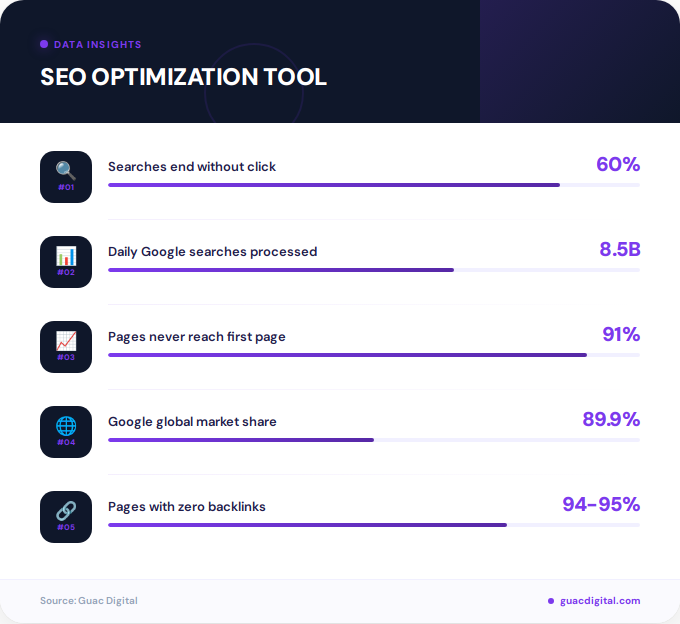
Imagine investing thousands of dollars in content creation, only to watch your competitors consistently outrank you. This happens every single day to businesses that rely on guesswork instead of data. In 2026, when Google processes 8.5 billion searches per day and 91% of pages never reach the first page without continuous optimization, choosing the right SEO optimization tool isn’t just helpful. It’s essential for survival.
The landscape has shifted dramatically. Zero-click searches now account for 60% of all queries, AI Overviews are reshaping how content gets discovered, and traditional ranking isn’t the only metric that matters anymore. Your SEO strategy needs tools that can navigate this complex, AI-driven environment while still delivering on the fundamentals.
What Is an SEO Optimization Tool?
An SEO optimization tool is specialized software designed to help you improve your website’s visibility in search engines by automating and streamlining critical tasks. These platforms handle everything from identifying the right keywords to tracking how well your pages perform in search results.
Modern SEO optimization tools have evolved far beyond basic keyword tracking. Today’s platforms integrate technical site audits, competitor analysis, content optimization recommendations, backlink monitoring, and increasingly, AI search visibility tracking. According to Google’s SEO Starter Guide, these tools help implement best practices at scale, something nearly impossible to do manually for most businesses.
The best SEO optimization tools now address the fundamental shift happening in search. They track not just where you rank on traditional search engine results pages, but also how often your brand appears in AI-generated answers, featured snippets, and zero-click result formats. This matters because professional SEO services increasingly focus on capturing visibility across all these touchpoints, not just organic position one.
Why Should Your Business Use an SEO Optimization Tool in 2026?
The short answer: because organic search still drives 94% of all clicks, according to comprehensive SEO statistics from AIOSEO. Despite the rise of social media and paid advertising, search remains the dominant way people discover new content, products, and services online.
But there’s more to the story. Google maintains an 89.9% global market share in 2026, meaning your search optimization primarily targets one platform with constantly evolving algorithms. Keeping up with these changes manually is impossible. An SEO optimization tool gives you real-time insights into what’s working, what’s broken, and where opportunities exist.
Consider the competitive landscape. Only 22% of pages reach the first page after one year, and that’s with active optimization efforts. Without data-driven tools, your chances drop even further. Meanwhile, 94-95% of pages have zero backlinks, meaning most content languishes in obscurity simply because it wasn’t optimized properly from the start.
For businesses working with comprehensive SEO optimization services, these tools provide the foundation for strategic decision-making. They replace guesswork with evidence, showing exactly which actions will move the needle on your visibility and traffic.

What Are the Essential Features of Modern SEO Tools?
Not all SEO optimization tools are created equal. The platforms that deliver real results in 2026 share several critical capabilities:
Keyword research and tracking remains foundational. Your tool should identify high-value search terms, show search volume and competition levels, and track your rankings over time. But it should also surface question-based queries and long-tail variations that AI search engines favor.
Technical SEO audits automatically scan your site for issues that harm rankings: broken links, slow page speeds, mobile usability problems, duplicate content, and crawl errors. The best tools prioritize these issues by impact, so you fix what matters most first.
Content optimization features analyze your existing pages and suggest improvements. This includes keyword density recommendations, readability scores, meta tag optimization, and competitive gap analysis showing what top-ranking competitors include that you don’t.
Backlink analysis helps you understand your site’s authority profile. Quality tools show who links to you, identify toxic links that could trigger penalties, and reveal link-building opportunities by analyzing competitor backlink profiles.
Rank tracking across devices and locations is essential because results vary dramatically. A search in New York shows different results than Miami, and mobile rankings differ from desktop.
AI Overview and zero-click monitoring represents the newest frontier. Forward-thinking platforms now track whether your content appears in Google’s AI-generated answers, featured snippets, and other zero-click formats. This matters immensely when 60% of searches don’t result in a click.
What Do the 2026 Data and Statistics Tell Us?
The numbers paint a clear picture of where search optimization stands today. Google processes approximately 8.5 billion searches daily, representing an enormous opportunity for visibility. Yet capturing that visibility has become increasingly complex.
Click-through rates reveal a stark hierarchy. According to Reboot Online’s comprehensive SEO statistics report, the top organic result captures 27.6% of all clicks, while AIOSEO reports this number reaches 34% on desktop searches. Position two sees roughly half that traffic, and by position ten, you’re capturing less than 2% of available clicks.
The zero-click phenomenon fundamentally changes the game. With 60% of searches ending without a click, traditional metrics like organic traffic tell an incomplete story. Your content might be highly visible in AI Overviews or featured snippets yet generate fewer site visits than expected.
| Metric | 2026 Value | Implication |
|---|---|---|
| Daily Google searches | 8.5 billion | Massive opportunity volume |
| Organic click share | 94% | SEO drives most website traffic |
| Zero-click searches | 60% | Visibility without traditional traffic |
| Pages reaching page one | 22% after one year | Continuous optimization required |
| Pages with no backlinks | 94-95% | Link building remains critical |
Interestingly, 52% of sources cited in Google AI Overviews rank in the top 10 organic results. This suggests that traditional SEO fundamentals still influence AI visibility. You can’t bypass ranking work by focusing only on AI optimization, but you do need to optimize specifically for how AI surfaces extract and present information.
Content length correlates strongly with performance. Pages exceeding 3,000 words earn 3x more traffic, 4x more shares, and 3.5x more backlinks compared to average-length content. This doesn’t mean every page should be long, it means comprehensive, authoritative content continues to outperform thin pages.
Mobile traffic now represents 60% of global web traffic, making mobile optimization non-negotiable. Your SEO optimization tool must test and track mobile performance separately from desktop.
How Big Is the SEO Tool Market and Where Is It Heading?
The SEO tool and services market has reached impressive scale. Multiple sources report market values in 2026 ranging from $83.9 billion to $108.28 billion, with projections suggesting growth to $148.86 billion to $203 billion by 2030.
| Source | 2026 Market Size | 2030 Projection |
|---|---|---|
| AIOSEO | $83.98B | $148.86B |
| Reboot Online | $83.9B | 39.8% growth projected |
| Xamsor | $108.28B | $203B |
The variation reflects different market definitions. Some sources count only software subscriptions, while others include agency services, consulting, and broader digital marketing technology stacks. Regardless of the exact figure, the trend is unmistakable: businesses are investing heavily in search optimization.
This growth is driven by several factors. First, the sheer volume of online competition continues to increase. Second, the complexity of ranking has escalated with algorithm updates, AI integration, and multi-platform search behaviors. Third, the measurable ROI of organic search remains compelling compared to paid channels.
For businesses exploring professional SEO implementation, this market maturity means more sophisticated tools, better integrations, and more specialized solutions than ever before.
What Types of SEO Optimization Tools Exist?
The SEO tool landscape breaks down into several categories, each addressing different aspects of optimization:
All-in-one platforms like SEMrush, Ahrefs, and Moz provide comprehensive toolsets covering keyword research, site audits, rank tracking, backlink analysis, and competitive intelligence. These work well for agencies and in-house teams managing multiple domains or complex strategies. They typically range from $100 to $500+ monthly depending on features and data limits.
Specialized keyword research tools such as LowFruits focus specifically on finding low-competition, high-opportunity keywords. According to LowFruits’ content optimization tool comparison, specialized tools often surface opportunities that broader platforms miss because they use different data sources or algorithms.
Technical SEO audit platforms like Screaming Frog and Sitebulb crawl your site to identify technical issues. These tools excel at finding crawl errors, redirect chains, missing meta tags, slow-loading resources, and other technical factors that impact rankings.
Content optimization platforms including Clearscope, MarketMuse, and Surfer SEO analyze top-ranking content and provide detailed recommendations for improving your own pages. These tools have become essential as Google’s algorithms increasingly reward comprehensive, well-structured content.
Rank tracking tools monitor your position in search results over time. While most all-in-one platforms include this feature, dedicated rank trackers often provide more granular data, including local rankings, mobile vs desktop differences, and competitor tracking.
AI SEO tools represent the newest category. Platforms like those featured in coverage of AI-powered SEO optimization and AI-driven SEO strategies specifically target optimization for ChatGPT, Perplexity, Google Bard, and other AI search interfaces.
How Are AI and Answer Engines Changing SEO Tools?
The integration of artificial intelligence into search has fundamentally altered what SEO optimization tools need to track. Traditional metrics focused exclusively on SERP rankings and organic traffic. Today’s tools must monitor a broader ecosystem of visibility signals.
AI Overview citations represent a new form of visibility. When Google generates an AI-powered answer, it typically cites sources. Getting your content cited in these answers drives brand awareness and authority, even if it doesn’t generate direct clicks. Tools now track whether your content appears in these citations.
Featured snippet optimization has become more sophisticated. Because AI answers often pull from featured snippets, optimizing for these rich results provides a dual benefit. Modern tools analyze snippet triggers and recommend specific formatting, length, and structure to increase your chances of winning these positions.
Entity-based optimization matters more than ever. AI search engines understand entities (people, places, things, concepts) and their relationships. Your SEO optimization tool should help establish your brand as a recognized entity and build topical authority in your niche.
“SEO is becoming ‘search everywhere optimization.’ Businesses are increasingly optimizing not just for Google, but for visibility across multiple search and answer surfaces, including AI-generated experiences. The tools that succeed in this environment are those that track performance across all these channels, not just traditional organic rankings.” – Reboot Online 2026 SEO Statistics Report
Conversational query optimization addresses how people interact with AI search tools. These queries tend to be longer, more question-based, and contextual. Your SEO optimization tool should identify these conversational keywords and help you structure content to answer them naturally.
Content freshness tracking has gained renewed importance. AI systems favor recently updated, current information. Tools now alert you when your content becomes outdated relative to competitors and suggest refresh opportunities.
How Do You Choose the Right SEO Optimization Tool?
Selecting the right platform depends on your specific situation, goals, and resources. Start by assessing your needs across several dimensions.
Consider your technical expertise. Some tools assume significant SEO knowledge, while others provide guided workflows and explanations suitable for beginners. If you’re new to SEO, prioritize platforms with strong educational resources and intuitive interfaces.
Evaluate the scope of your SEO program. Managing a single small website requires different capabilities than overseeing 50 domains across multiple countries. All-in-one platforms make sense for complex operations, while focused tools may suffice for simpler needs.
Assess integration requirements. Your SEO optimization tool should connect with your existing marketing stack. Look for integrations with your CMS, analytics platform, CRM, and other tools you rely on daily. API access matters for custom reporting and automation.
Examine data accuracy and freshness. Not all tools pull from the same data sources, and some update more frequently than others. For competitive industries where rankings shift daily, real-time or daily updates are essential. For less competitive niches, weekly updates may suffice.
Review reporting and collaboration features. If you work with a team or need to report to stakeholders, look for customizable dashboards, white-label reports, user permissions, and sharing capabilities.
Test customer support quality. When rankings drop or technical issues arise, responsive support makes a significant difference. Review support channels (email, chat, phone), availability (business hours vs 24/7), and response times.
Most quality platforms offer free trials. Test several options with your actual website before committing. Focus on how intuitive the workflow feels and whether the insights provided are actionable for your specific situation.
What Should You Expect to Invest in SEO Tools?
SEO optimization tool pricing varies dramatically based on features, data limits, user count, and sophistication. Monthly subscriptions typically range from $30 to $500+ for individual or small business plans, while enterprise platforms can reach $1,000 to $10,000+ monthly for advanced features and unlimited usage.
Free tools exist and can provide value for basic needs. Google Search Console and Google Analytics offer foundational data every website owner should use. Free tiers of paid platforms often include limited keyword research, basic site audits, and restricted rank tracking.
Mid-tier platforms ($100-$300/month) typically provide comprehensive features suitable for small to medium businesses. These include robust keyword databases, regular site audits, backlink monitoring, and rank tracking for multiple keywords and competitors.
Premium and enterprise tools ($500-$10,000+/month) add extensive historical data, API access, white-label reporting, dedicated account management, custom integrations, and unlimited or very high usage limits. These make sense for agencies managing multiple clients or large enterprises with complex optimization programs.
The investment should align with the value you extract. For businesses where organic search drives significant revenue, spending several hundred dollars monthly on tools that maintain or improve rankings delivers clear ROI. Calculate your average customer value and the incremental traffic or conversions that improved rankings would generate.
Many businesses find that combining a primary all-in-one platform with one or two specialized tools provides the best balance of coverage and cost. For example, you might use SEMrush as your main platform while adding a specialized content optimization tool for your writers.
When evaluating SEO optimization service costs, remember that professional services typically include tool access as part of their offering. Agencies invest in enterprise-level tools and pass that capability to clients without the client needing separate subscriptions.
Key Takeaways
- SEO optimization tools are essential, not optional in 2026, with Google processing 8.5 billion searches daily and organic search driving 94% of all clicks. Manual optimization cannot compete at scale.
- Zero-click searches and AI Overviews have fundamentally changed visibility metrics. With 60% of searches ending without a click and 52% of AI Overview citations coming from top-10 rankings, modern tools must track more than just organic position.
- The SEO tool market has reached $83.9B to $108.28B in 2026 and continues growing rapidly, reflecting both the complexity of modern search optimization and its proven ROI for businesses.
- Content depth and technical excellence remain critical. Pages over 3,000 words earn 3x more traffic, while 91% of pages never reach page one without continuous optimization and proper technical foundations.
- Tool selection should match your specific needs, expertise, and scale. All-in-one platforms work well for complex operations, while specialized tools may suffice for focused needs. Free trials let you test before committing.
- Investment in quality SEO tools delivers measurable ROI when organic search drives significant business value. Monthly costs range from $30 for basic tools to $10,000+ for enterprise platforms, but should be evaluated against the revenue impact of improved rankings.
- AI integration is now a requirement, not a nice-to-have. Modern tools must optimize for traditional search engines and AI answer engines simultaneously, tracking citations, featured snippets, and entity recognition alongside classic ranking metrics.
People Also Ask
What is the best free SEO optimization tool?
Google Search Console is widely considered the best free SEO optimization tool because it provides direct data from Google about how your site appears in search, including impressions, clicks, average position, and technical issues. Combined with Google Analytics for traffic insights, these free tools cover essential optimization needs for many small businesses.
How do SEO tools improve website rankings?
SEO tools improve rankings by identifying optimization opportunities you wouldn’t find manually, including high-value keywords to target, technical errors harming your site’s crawlability, content gaps compared to competitors, and backlink opportunities. They provide data-driven recommendations that, when implemented correctly, help search engines better understand, crawl, and rank your content.
Can SEO tools guarantee first page rankings?
No reputable SEO tool can guarantee first-page rankings because search engines use complex, constantly-changing algorithms that no external party fully controls. However, quality tools significantly increase your chances by identifying what top-ranking competitors do, surfacing technical issues, and tracking your progress so you can refine your strategy based on what works.
What’s the difference between SEO tools and SEO services?
SEO tools are software platforms that provide data and recommendations, while SEO services involve human experts who use those tools to execute strategy on your behalf. Tools give you the information, but services include the expertise, time, and ongoing optimization work required to actually implement improvements and adapt to algorithm changes.
How long does it take to see results from SEO tools?
Technical fixes identified by SEO tools can improve site performance within days, but ranking improvements typically take 3-6 months to materialize because search engines need time to recrawl your site, evaluate changes, and adjust rankings. Statistics show only 22% of pages reach page one after one year, emphasizing that SEO is a long-term investment requiring consistent effort.
Do I need different tools for mobile and desktop SEO?
Modern SEO tools track both mobile and desktop performance within a single platform, which is essential because mobile now represents 60% of global web traffic and Google uses mobile-first indexing. You don’t need separate tools, but you do need a tool that specifically reports on mobile usability, page speed, and ranking differences between devices.
Frequently Asked Questions
What SEO optimization tool do professionals use most?+
Most SEO professionals use all-in-one platforms like SEMrush, Ahrefs, or Moz as their primary tool, often supplemented with specialized platforms for content optimization, technical audits, or rank tracking. The choice depends on specific needs, budget, and the tool’s integration with existing workflows.
Should small businesses invest in expensive SEO tools?+
Small businesses should start with free tools like Google Search Console and Analytics, then consider mid-tier platforms ($100-300/month) once they’re actively producing content and have budget to implement recommendations. The investment makes sense when the incremental revenue from improved rankings exceeds the tool cost, which varies by industry and competition level.
How accurate are SEO tool keyword volume estimates?+
Keyword volume estimates vary significantly between tools and are approximations rather than exact figures. Most tools provide data within 20-40% accuracy for high-volume terms but can be less reliable for long-tail keywords with lower search volume. Use estimates for relative comparison rather than treating them as precise metrics.
Can SEO tools help with local search optimization?+
Yes, most comprehensive SEO tools include local search features that track rankings by city or region, analyze local competitors, monitor Google Business Profile performance, and identify local keyword opportunities. Some tools also manage citation building and review monitoring, which are critical for local visibility.
Do SEO tools work for e-commerce sites?+
E-commerce sites benefit significantly from SEO tools because they typically have hundreds or thousands of product pages that need optimization. Tools help identify product-specific keywords, flag technical issues like duplicate content or broken links, track category page rankings, and analyze competitor product strategies at scale.
How do I know if an SEO tool is worth the investment?+
Calculate the potential value of ranking improvements the tool could enable. If improving your position for key terms would generate an additional $5,000 monthly in revenue, a $200/month tool cost is easily justified. Also consider time savings: if the tool automates tasks that currently take 10+ hours monthly, the efficiency gain alone may justify the cost.
What’s the difference between SEO tools and website analytics?+
Website analytics like Google Analytics show what happens on your site after visitors arrive, tracking behavior, conversions, and traffic sources. SEO tools focus on what happens before the click, analyzing search visibility, keyword opportunities, technical health, and competitive positioning. Both are essential, and they complement each other in a complete optimization strategy.
Further reading: Local SEO Tips for Small Businesses: The Complete 2026 Playbook
Further reading: Local SEO Services: The Complete 2026 Guide to Ranking, Reviews, and Revenue