
SEO Artificial Intelligence Tools 2025: Unbeatable
Why SEO Artificial Intelligence Tools Are Revolutionizing Digital Marketing
SEO artificial intelligence tools are changing search engine optimization by automating complex tasks, providing deeper insights, and delivering results faster than ever. These platforms use machine learning to analyze massive datasets, predict search trends, and optimize content with incredible precision. The adoption is widespread, with 86% of SEO professionals already using AI and 65% of businesses reporting better SEO results.
This shift is about staying competitive in a digital landscape where manual optimization can’t match AI’s speed and accuracy. The rise of AI search engines and Google’s AI Overviews has also created new challenges, requiring tools that can track brand visibility across these platforms through Generative Engine Optimization (GEO).
I’m Guy Leon, founder of Guac Digital, and I’ve seen how SEO artificial intelligence tools have revolutionized our client campaigns, boosting engagement by 350%. These tools are essential for any business serious about dominating search results in 2025.
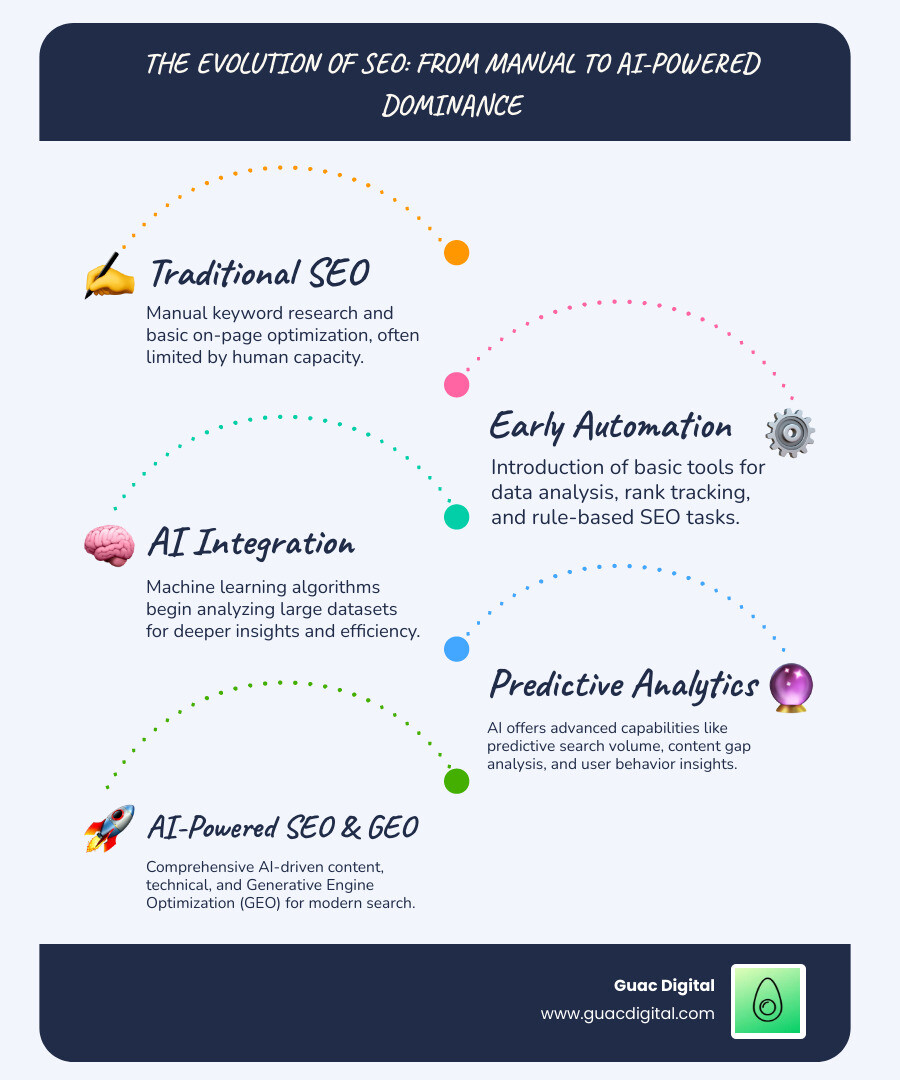
Seo artificial intelligence tools glossary:
The AI Advantage: How AI SEO Tools Differ from Traditional Software
Traditional SEO software is like a calculator: you input data, and it provides reports based on pre-programmed rules. It shows you what happened, but not why. In contrast, SEO artificial intelligence tools act like a brilliant analyst, not only processing data but also predicting future trends, explaining patterns, and automating tedious tasks so you can focus on strategy.
Traditional platforms operate on rule-based systems. They might report a drop in keyword rankings, leaving you to figure out the cause. AI tools, however, use machine learning to think more like humans. They analyze patterns across massive datasets to uncover insights you’d miss manually. When rankings drop, AI can correlate dozens of factors—from competitor content changes to search behavior shifts—and suggest specific recovery actions.

Predictive analytics is where AI truly shines, allowing you to forecast search trends and adjust strategies proactively. Task automation is another game-changer, with AI handling tasks like generating schema markup or suggesting internal links. The deeper insights from user behavior analysis help you understand not just what people search for, but why. At Guac Digital, we’ve seen how leveraging Why Big Data is a Big Deal in Advertising transforms client results, and AI is the engine powering that change.
Primary Benefits of Using AI in Your SEO Strategy
With 65% of businesses seeing better SEO results after adopting AI, the benefits are clear. Here’s what that looks like in practice:
- Increased efficiency: AI handles tasks like competitor research or site audits in minutes, not hours, freeing up your team for more strategic work.
- Improved accuracy: AI algorithms maintain precision across massive datasets, eliminating the human error common in manual data processing.
- Improved personalization: By understanding search intent at a granular level, AI helps create content that speaks directly to user needs, improving engagement and conversions.
- Scalability: AI manages the heavy analytical lifting, allowing you to handle more projects without proportionally increasing team size.
- Competitive edge: While competitors manually analyze data, you can implement AI-driven optimizations, giving you a significant advantage.
Our approach at Guac Digital is rooted in Data-Driven Marketing Strategies: Your Blueprint for Success, and AI amplifies every aspect of this philosophy.
Understanding the Shift to Generative Engine Optimization (GEO)
Users are increasingly turning to AI Overviews and other generative AI platforms for answers, creating a new optimization frontier: Generative Engine Optimization (GEO). This means optimizing for brand visibility within these AI-powered platforms, not just traditional search engines.
AI search graders now analyze how well brands appear in AI-generated responses, scoring brand sentiment and share of voice. We are now tracking AI citations to understand how our clients’ brands are mentioned in AI conversations. This requires a different approach, as AI systems analyze context, helpfulness, and authority. Your content must be genuinely valuable, not just keyword-optimized, to ensure your expertise is established across multiple touchpoints.
This evolution builds on fundamental SEO principles, which you can explore in What is Search Engine Optimization?, but AI has accelerated everything, opening new opportunities for visibility.
Core Capabilities: Key Features to Look for in SEO Artificial Intelligence Tools
When evaluating SEO artificial intelligence tools, it’s helpful to understand the main categories. All-in-one platforms offer comprehensive suites with AI-improved features for keyword research, competitor analysis, and technical audits. Content-focused platforms specialize in AI-driven content analysis and optimization, analyzing on-page signals to deliver personalized recommendations. Finally, technical SEO automation tools handle backend work, using AI-powered crawlers to identify site issues quickly.
| Tool Category | Key Features |
|---|---|
| All-in-One Platforms | Comprehensive keyword research, competitor analysis, rank tracking, technical audits, AI-improved insights across all SEO functions |
| Content Optimization Tools | AI content generation, on-page optimization suggestions, NLP analysis, readability scoring, automated meta descriptions |
| Technical AI Tools | Automated site crawls, indexing automation, schema markup generation, page speed analysis, internal linking suggestions |
What sets these tools apart is their ability to learn from data, explaining why things happen and predicting what’s next. This shift from data reporting to predictive guidance is transformative. To Boost Your Online Presence with Expert SEO Services, leveraging these AI-powered features is a necessity.
Supercharging Keyword Research and Competitor Analysis
SEO artificial intelligence tools have turned keyword research into a predictive science. Key capabilities include:
- Keyword Clustering: AI groups semantically related keywords to build topic clusters, signaling authority to search engines.
- Search Intent Analysis: AI determines if a user’s intent is informational, transactional, or navigational, allowing for more resonant content.
- Predictive Search Volume: Some tools forecast search trends, revealing emerging opportunities before they become competitive.
- Content Gap Identification: AI compares your content against top competitors to pinpoint missed topics and opportunities.
- Competitor Strategy Analysis: AI can reverse-engineer competitor strategies by analyzing their top content, backlinks, and keyword patterns.
These features help uncover valuable long-tail keyword opportunities that drive highly qualified traffic. Using a Google Ranking Check Tool alongside these AI insights creates a powerful competitive advantage.
Enhancing Content with SEO Artificial Intelligence Tools
AI has become an essential advisor for content creation. AI content generation can assist with drafting articles, headlines, and meta descriptions, speeding up the initial process. The real game-changer is real-time on-page optimization suggestions, which analyze keyword density, readability, and internal linking as you write.
Natural Language Processing (NLP) analysis helps create comprehensive content that satisfies complex queries, while readability scoring ensures your writing engages the target audience. AI can also generate detailed content briefs based on competitor analysis and automate meta descriptions to improve click-through rates. Our SEO Copywriting and Content Optimization Services are now boostd by these intelligent tools.
Automating Technical Audits with SEO Artificial Intelligence Tools
Technical SEO is far more manageable with AI. Automated site crawls efficiently scan websites for broken links, redirect chains, and duplicate content. Indexing automation helps get new pages indexed quickly, a major advantage for content velocity.
AI also simplifies schema markup generation, provides deep page speed insights with actionable recommendations, and offers strategic internal linking suggestions to improve site navigation and authority. By automatically identifying and prioritizing crawl errors, AI turns complex technical challenges into clear action items, enhancing our Site Audit process with unprecedented speed and accuracy.
Refining Local SEO and Rank Tracking
For local businesses, SEO artificial intelligence tools offer powerful advantages. Local keyword tracking provides precise visibility insights across different cities or regions. AI also provides citation management suggestions to build local authority and can perform review analysis using sentiment analysis to extract customer feedback themes.
Automated reporting compiles local performance metrics, saving time while providing detailed insights. Crucially, advanced tools now offer rank tracking in AI Overviews, helping you monitor visibility in Google’s AI-generated answers. This sophisticated analysis ensures our Local Search Engine Optimization Services are more precise and impactful than ever.
Choosing Your AI Ally: How to Select the Right Tool
Picking the right SEO artificial intelligence tools requires a methodical approach. With dozens of platforms available, the key is finding the perfect match for your specific needs.
- Start with your business goals. Are you focused on content creation, local SEO, or e-commerce? Your primary objective should guide your choice.
- Consider your budget. Many tools offer free trials or freemium versions. Test them before committing. The most expensive tool isn’t always the best for your situation.
- Think about scalability. Choose a tool that can grow with your business, from 10 pages to 10,000.
- Ensure integration. Your AI tool should connect seamlessly with your existing marketing stack (CMS, analytics, etc.) to avoid manual data transfers.
- Prioritize user-friendliness. A powerful tool is useless if your team can’t use it. Look for clean interfaces and good customer support.

However, it’s important to acknowledge the limitations. AI isn’t perfect; it can sometimes provide incorrect information, so human oversight is crucial to verify recommendations. Avoid over-reliance on AI, as it should assist, not replace, strategic thinking and creativity. Be aware of data accuracy challenges, as AI models are only as good as their training data. Finally, consider the ethical implications regarding content originality and potential bias to protect your brand’s reputation.
Choosing the right AI tools is like Choosing the Right Digital Marketing Agency for Business Growth—it requires careful consideration of capabilities, limitations, and long-term goals.
The Future is Now: AI’s Impact on SEO and Ethical Considerations
The search landscape is rapidly evolving, and SEO artificial intelligence tools are reshaping what search engines expect from content.

Google’s E-E-A-T framework (Experience, Expertise, Authoritativeness, and Trustworthiness) is more important than ever. As the primary aim of this important update is to assist Google in identifying which sites possess authority and trustworthiness online, it’s clear Google is prioritizing quality content over the flood of AI-generated material.
Interestingly, Google doesn’t penalize content simply for being AI-written. According to Google’s guidance on AI-generated content, the focus is on helpfulness. Using AI to manipulate rankings with spammy content violates their policies, but using it to create helpful content is acceptable. The Helpful Content System is designed to reward quality, regardless of origin.
This raises important ethical considerations. Human oversight is critical; AI should augment human judgment, not replace it. Every piece of AI-assisted content needs fact-checking and the nuance that comes from real expertise. Resisting the temptation to prioritize content quantity over quality is vital, especially for YMYL (Your Money, Your Life) topics where accuracy is paramount. We must also remain vigilant against algorithmic bias and maintain transparency with our audience.
The future of SEO lies in combining the efficiency of SEO artificial intelligence tools with human creativity, strategy, and ethical judgment. This collaboration creates content that is both technically optimized and genuinely valuable.
Frequently Asked Questions about AI SEO Tools
We get many questions from clients about these powerful new tools. Here are answers to the most common concerns.
Can Google detect AI-generated content, and is it bad for SEO?
Yes, Google can likely detect AI-generated content, but their focus isn’t on the origin. What Google truly cares about is whether your content is helpful, accurate, and valuable to users.
Their official stance is clear: using AI to create low-quality content for manipulating rankings is spam. However, using SEO artificial intelligence tools to produce genuinely helpful content is perfectly fine. The key is adhering to E-E-A-T (Experience, Expertise, Authoritativeness, Trustworthiness). High-quality, helpful content gets rewarded, whether it was drafted by a human or assisted by AI. Think of it as a quality-over-origin approach.
Can AI completely replace human SEO professionals?
No, AI is not replacing human SEO professionals. Instead, it’s changing their roles. SEO artificial intelligence tools are incredible at data analysis, pattern recognition, and automating repetitive tasks. They act as powerful assistants.
However, humans are still essential for strategic thinking, creativity, brand voice, and interpreting complex market dynamics. An AI can’t replicate the nuanced understanding of a business’s goals or steer a surprise Google algorithm update with strategic insight. The future is a partnership: human creativity and strategy improved by machine efficiency. Our team now focuses more on high-level strategy while AI handles the analytical heavy lifting.
How do I choose the right AI SEO tool for a small business?
For a small business, the right tool solves your biggest problems without breaking the bank.
First, clarify your main SEO pain points, whether it’s keyword research, content creation, or technical audits. Let your needs guide your choice. Take advantage of free trials to test tools before you buy. Many platforms offer robust free versions.
Focus on budget-friendly tools that excel in your priority areas rather than expensive all-in-one suites. User-friendliness is crucial, so look for intuitive interfaces. Finally, choose tools with flexible pricing that can scale as your business grows.
If you’re overwhelmed, consider working with a Small Business SEO Company that has already mastered these tools and can implement them strategically for you.
Conclusion: Using AI for Unbeatable SEO Performance
The digital marketing world has reached a turning point, with SEO artificial intelligence tools rewriting the playbook. We’ve seen how these platforms transform every aspect of search optimization, from supercharging keyword research to automating complex technical audits.
This AI revolution makes sophisticated SEO accessible to all businesses. The increased efficiency allows teams to focus on strategy and creativity, while the improved accuracy of AI-powered insights ensures decisions are data-backed. The rise of Generative Engine Optimization has also opened new frontiers for brand visibility in AI chat interfaces and Overviews.
At Guac Digital, the strategic implementation of these tools has helped us boost client engagement by 350%. We’ve learned that human expertise remains key; AI amplifies our capabilities but doesn’t replace the strategic thinking that drives exceptional campaigns. The businesses that thrive today understand that these tools are no longer optional—they are essential for search dominance.
Ready to harness the power of AI for your SEO strategy? Explore our AI-driven marketing successes in our portfolio and find how the blend of artificial intelligence and human creativity can transform your digital presence.