
How to Manage a Bad Google Review for SEO: 3-Step Savior
The Hidden SEO Threat Lurking in Your Google Reviews
How to manage a bad google review for seo is a critical skill that can make or break your online visibility. For immediate action, follow this strategy:
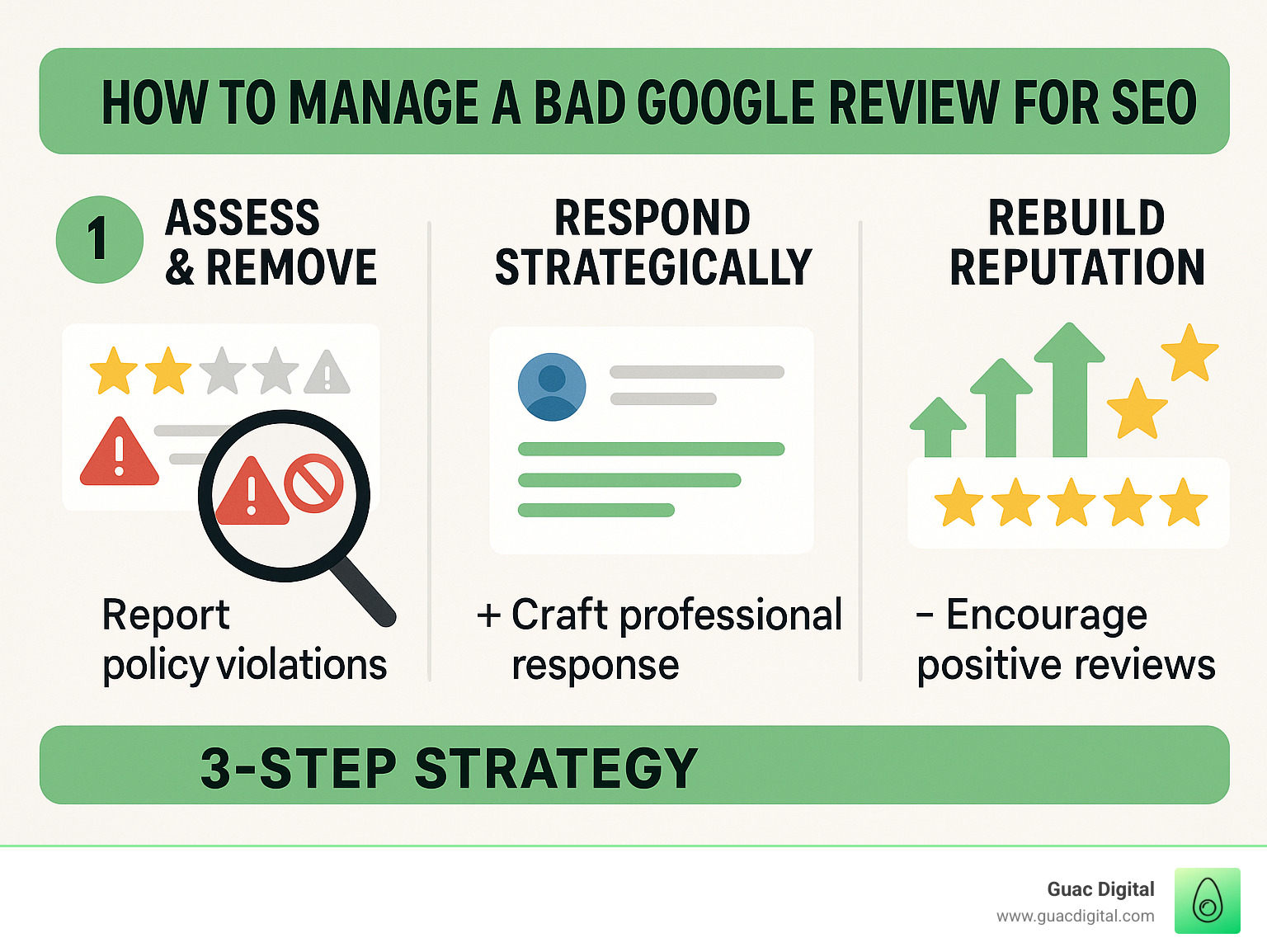
3-Step Strategy for Managing Bad Google Reviews:
- Assess & Remove – Report reviews that violate Google’s policies (e.g., fake, spam, hate speech).
- Respond Strategically – Craft professional, empathetic responses that show accountability.
- Rebuild Reputation – Proactively encourage positive reviews to dilute any negative impact.
A single negative review can feel like a digital nightmare. One frustrated customer clicks “post,” and suddenly your business appears less trustworthy. But here’s what most business owners don’t realize: how you handle that review matters more for SEO than the review itself.
Negative reviews don’t just hurt your reputation—they directly impact your local SEO rankings, click-through rates, and bottom line. The good news? Bad reviews are opportunities to demonstrate exceptional customer service, potentially turning critics into advocates.
I’m Guy Leon, founder of Guac Digital. I’ve helped countless businesses transform online reputation challenges into competitive advantages. Through strategic review management, we consistently improve our clients’ local search visibility and customer trust.
The Real SEO Impact of a Bad Google Review
Picture this: you’re searching for a plumber. You see three options. One has 4.8 stars, another has 4.5, and the third has 3.2 stars with a glaring one-star review at the top. Which one are you calling first?

This scenario is why how to manage a bad google review for seo is a critical business skill. Star ratings are powerful signals that influence both Google’s algorithms and customer behavior. Google treats reviews as a prominence signal. When deciding which businesses to show in local search, it views reviews as a key indicator of quality and trustworthiness. According to Whitespark’s research, “Online reviews are the fourth most important factor in local SEO ranking.”
Negative reviews create a domino effect. When potential customers see low ratings, they’re less likely to click on your listing, reducing your click-through rate (CTR). Google notices this and may interpret it as a sign that your business is less appealing, potentially pushing you lower in search results.
BrightLocal’s Local Consumer Review Survey consistently shows how heavily consumers rely on reviews. It’s not just about losing one customer; it’s about the ripple effect on your entire digital presence. Understanding local SEO fundamentals, including review management, is crucial, as we detail in our Local SEO for Small Business guide.
Why Star Ratings and Review Quantity Matter
The math behind reviews is telling. 85% of searchers consider the star rating average ‘important’ or ‘very important’, according to research from BrightLocal. That’s a make-or-break factor for most potential customers.
Your star rating average is your digital first impression. But the total number of reviews matters just as much. A business with five perfect 5-star reviews might seem less credible than one with 200 reviews averaging 4.3 stars, because consumers know that real businesses aren’t perfect.
Review recency is another key factor. Google and customers both favor fresh feedback, with 73% of shoppers influenced by recent reviews. An old negative review carries less weight when surrounded by recent positive ones.
Interestingly, customers find a mix of reviews more trustworthy than a perfect 5.0 rating. In fact, 96% of customers specifically look for negative reviews to understand potential issues and see how you handle them. This is where mastering how to manage a bad google review for seo becomes your secret weapon. Reviews are user trust signals that Google uses to determine your credibility and relevance.
First Line of Defense: Removing Reviews That Violate Policy
Your first instinct with a negative review might be to delete it. However, Google won’t remove a review simply because it’s negative. That would be unfair to consumers. Google acts as a neutral platform and will only remove reviews that violate its specific content policies. This is your first legitimate line of defense when learning how to manage a bad google review for seo.

Avoid shady “reputation management” services that promise guaranteed removal. Unethical tactics like fake DMCA notices can backfire and lead to severe penalties from Google. At Guac Digital, we focus on legitimate, sustainable strategies. For a deeper dive, see our guide on How to Remove Bad Reviews from Google My Business.
Understanding Google’s Prohibited Content Policies
Understanding Google’s rules is crucial. The key is recognizing when a review crosses the line from negative criticism to a policy violation. Common violations include:
- Spam and fake content: Reviews from bots, fake profiles, or competitors. In 2023, Google blocked over 170 million fake reviews.
- Off-topic content: Reviews that complain about things unrelated to your business, like city parking.
- Offensive content: Hate speech, personal attacks, harassment, or excessive profanity.
- Conflict of interest: Reviews from current or former employees, competitors, or business owners reviewing their own company.
- Other violations: Impersonation, content about restricted products, or illegal activities.
You can find complete details in Google’s prohibited and restricted content policies. Bookmark this page for reference.
The Step-by-Step Removal Process
If you identify a review that violates policy, follow this legitimate process:
- Flag the review directly. Find the review on Google Maps or Search, click the three dots, and select “Report review.” You can also do this from your Google Business Profile Manager.
- Track your progress. Use Google’s Reviews Management Tool to monitor the status of your report and submit a one-time appeal if denied.
- Provide solid evidence. When reporting, include supporting documentation if possible. If you have no record of the customer, mention that. Screenshots or transaction records can strengthen your case.
- Escalate to Google Support. If a review is stuck in “Pending” or a legitimate request is denied, contact Google Support directly through your Business Profile dashboard. Be clear, provide your case ID, and reference the specific policy violation.
- For legal issues like defamation, use Google’s separate Report Content for Legal Reasons page. This is a complex process that typically requires a court order and legal counsel.
Patience is essential. Google usually takes a few business days to review flags, and appeals can take longer. Following the proper process is the only way to have illegitimate reviews removed.
The Art of the Response: How to Manage a Bad Google Review for SEO When It Stays
Sometimes, a negative review doesn’t violate policy and will stay up. This is where many businesses miss a huge opportunity. When you master how to manage a bad google review for seo through strategic responses, you’re not just talking to one unhappy customer; you’re speaking to every future customer who reads that review.

Think of your response as a public showcase of your customer service. Potential customers are asking, “How will this business treat me if something goes wrong?” Your response gives them the answer. Research shows that 70% of consumers will trust a business more if they respond to negative reviews, and 94% of people still buy from companies that respond professionally.
Google also notices this engagement. As Google confirms, responsiveness improves your rankings because it demonstrates you’re an active, caring business.
Crafting the Perfect Response: A 4-Step Formula
We’ve developed a formula that turns criticism into credibility:
- Acknowledge and thank the reviewer. Start with gratitude: “Thank you for taking the time to share your experience.” This immediately defuses tension.
- Apologize sincerely and show empathy. You’re not admitting fault, you’re apologizing for their disappointment: “We’re truly sorry to hear that your experience didn’t meet your expectations.”
- Offer a solution or explanation without getting defensive. Keep it brief and solution-focused: “We’ve addressed this with our team to prevent similar issues.”
- Take the conversation offline. This is crucial. “Please contact our team at [your business email or phone number] so we can resolve this personally.”
Best practices for how to manage a bad google review for seo
- Be Timely: Respond within 24 hours to show you’re attentive.
- Stay Professional: Maintain a warm, understanding tone, even if the review feels unfair.
- Personalize: Use the reviewer’s name. Avoid generic, robotic responses.
- Don’t Argue Publicly: Once you’ve offered to take it offline, stick to it. Public arguments damage your reputation.
- Correct Misinformation Tactfully: If a claim is false, gently clarify without being aggressive. “We understand the confusion. Our policy is to provide all costs upfront, and we’d be happy to review your situation.”
Here’s an insider tip: naturally weaving keywords into your responses can provide a slight SEO boost. For example, a Tampa plumber might say: “As a Tampa plumber, we pride ourselves on reliable service.” Just keep it natural. A thoughtful response often builds more trust than a perfect 5-star rating ever could.
Proactive Reputation Building: Drown Out the Negative with Positive
Think of negative reviews like weeds in a garden. You can pluck them, but the best strategy is to plant so many flowers that the weeds become invisible. That’s how to manage a bad google review for seo most effectively: build such a strong foundation of positive feedback that any negative comment gets lost in the crowd.
This proactive strategy shifts you from putting out fires to building a reputation fortress. When you have 200 five-star reviews, a single one-star review barely moves your average. Google’s algorithms also notice when businesses consistently receive fresh, positive feedback, signaling that you’re actively serving customers well. This creates powerful social proof that builds trust. This holistic approach is part of what we cover in our Small Business SEO strategies.
How to Ethically Encourage More Positive Reviews
Never buy fake reviews or bribe customers. Google is smart about detecting artificial patterns, and the penalties are severe. Instead, make it incredibly easy for genuinely happy customers to share their experiences.
- Time the ask perfectly. The best moment is right after a positive interaction. When a customer expresses satisfaction, say, “I’m so glad you’re happy! If you have a minute, a Google review would mean the world to us.”
- Use email and SMS campaigns. Send a follow-up message 24-48 hours after service. Keep it personal and include a direct review link to eliminate friction.
- Make in-person requests. Train your team to recognize satisfied customers and ask naturally. Authenticity is key.
- Use QR codes. Place them on receipts, business cards, or table tents. A quick scan can take customers directly to your review page. You can create materials using Google’s free marketing kit.
The secret is a direct review link, which you can generate in your Google Business Profile. This takes customers straight to the review form, making the process seamless. Find out how with Google’s review link guide.
Why proactive management is key to how to manage a bad google review for seo
Managing your online reputation requires consistent attention. It’s digital customer service that never sleeps.
- Monitor your brand mentions. Set up Google Alerts for your business name to catch new reviews quickly.
- Use reputation management tools. The market offers a range of powerful platforms like Birdeye, Podium, and Yext that help automate review requests and monitor feedback across various sites. While these tools are excellent for managing high volumes, the most effective approach integrates them into a broader digital marketing strategy. At Guac Digital, we use analytics to identify patterns in customer feedback and create targeted campaigns that encourage reviews from your most satisfied customers, ensuring a personalized touch.
- Integrate feedback into operations. Treat every review as actionable business intelligence. If multiple customers mention the same issue, it’s data pointing to an improvement opportunity. We helped one client solve a recurring parking complaint by adding better signage and updating their Google Business Profile with detailed instructions. The complaints stopped, and satisfaction scores improved.
If you’re concerned about missing feedback, our guide on Missing Google Reviews? A Step-by-Step Recovery Guide can help. Proactive reputation management compounds over time, building a strong foundation that can weather any occasional negative feedback.
Frequently Asked Questions about Managing Google Reviews
When dealing with negative reviews, it’s natural to have questions. Here are the most common ones we hear from business owners learning how to manage a bad google review for seo.
Can a business delete a negative Google review?
No, businesses cannot delete reviews themselves. Google designed its system to maintain trust and authenticity. If businesses could remove any review they disliked, the platform would lose credibility.
The only way a review can be removed is if Google’s team removes it for violating their content policies. You can report a review, but the final decision rests with Google. This is why strategic management is so crucial.
How long does it take for Google to remove a review?
Patience is key. The timeline for Google to act on a reported review varies. Most reports are reviewed within a few business days, but the entire process can take anywhere from five days to several weeks, especially for complex cases or appeals.
Check the status of your report in the Reviews Management Tool and avoid submitting multiple reports for the same review, as this can slow the process down.
Is it a good idea to offer incentives for reviews?
This is a risky area. Offering incentives for reviews can violate Google’s policies against “fake engagement,” which is anything designed to manipulate ratings.
Offering rewards specifically for positive reviews is a clear violation. Even offering incentives for any review can be problematic if it influences what someone writes. It’s much safer to encourage honest feedback without direct compensation by making the review process easy and asking at the right time.
Getting caught manipulating reviews can lead to severe penalties, including the removal of your entire review profile or a drop in local search rankings. It’s not worth the risk.
Conclusion
Managing negative Google reviews doesn’t have to be a battle. With the right care and attention, even the occasional bad review can be handled effectively. Our 3-step strategy—Remove, Respond, Rebuild—provides a clear roadmap for turning challenges into opportunities.
Remove reviews that violate policy, respond strategically to build public trust, and rebuild by proactively encouraging positive feedback. This proactive approach creates a robust online presence that minimizes the impact of any negative comments.
Negative reviews are often your best teachers. They highlight blind spots and offer concrete areas for improvement. When you accept this feedback and make genuine changes, you’re not just managing your reputation—you’re improving your business.
At Guac Digital, we’ve seen countless businesses transform their online presence using these exact strategies. Our approach goes beyond quick fixes; we leverage data and programmatic marketing to create sustainable, long-term reputation management systems that deliver real ROI.
Ready to take control of your online reputation? Our Local Booster services are designed to help businesses like yours build a strong, positive online presence. It’s not about avoiding negative reviews—it’s about showing the world exactly how you handle them.