
Brand Identity Examples: Best Examples and What Makes Them Work
Quick Answer
The best brand identity examples, including Apple, Tripadvisor, and Made by Mitchell, work because they combine consistent visual systems with emotional authenticity and adaptability across channels. In 2026, winning brand identities treat sustainability as a baseline requirement, use AI-powered “living” design systems that flex by context, and prioritize human, nostalgic storytelling over sterile minimalism.
What Is Brand Identity, and Why Does It Matter More Than Ever?
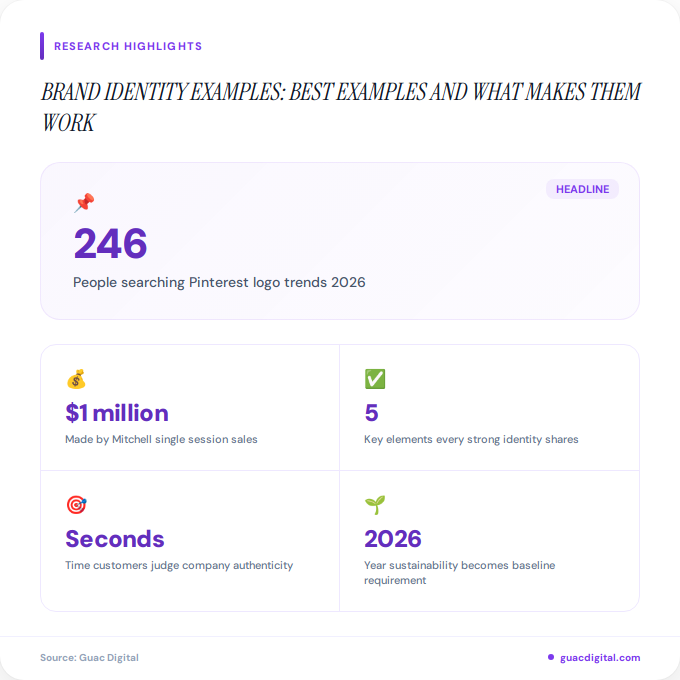
Only 246 people were actively searching Pinterest for “logo trends 2026” at the start of this year, according to Pinterest’s trend data on 2026 logo design. That number seems small, but it signals something bigger: brand identity is no longer a static design exercise. It’s a living system businesses revisit constantly, because customers now judge companies on visual consistency, emotional tone, and authenticity within seconds.
Brand identity examples matter because they show what actually works in the market, not just in theory. A strong identity is the complete visual and verbal system, logo, color palette, typography, tone of voice, and packaging, that makes a company instantly recognizable and trustworthy. Get it right, and customers form loyalty before they even read your value proposition.
Get it wrong, and even a great product struggles to gain traction. That’s why understanding real brand identity examples from companies that have succeeded, and failed, is one of the fastest ways to shortcut your own branding decisions.
What Are the Best Brand Identity Examples Right Now?
The most cited brand identity case studies share one trait: they extend beyond the logo into every touchpoint a customer experiences. Here are the standout examples shaping the conversation in 2026.
Apple: Vertical Branding Done Right
Apple remains the textbook example of what’s called “vertical branding,” where the product identity, packaging, retail environment, and digital experience are all engineered as one seamless system. As Stamina Marketing’s breakdown of vertical branding examples explains, Apple stores function as three-dimensional extensions of the brand’s minimalist visual language, reinforcing the same restraint customers see in product design and marketing.
Tripadvisor: Human-Centric, Nostalgic Rebrand
Tripadvisor’s 2025 rebrand anticipated a trend that’s now dominating 2026: a return to warmer, more human, more nostalgic design language after years of flat, tech-forward aesthetics. The rebrand rebuilt user trust by softening the brand’s visual tone and making the identity feel more approachable, a strategic bet that’s paying off as audiences grow fatigued with sterile corporate minimalism.
Made by Mitchell: Identity Powered by Experience
Cosmetics brand Made by Mitchell proved that brand identity isn’t confined to static assets. By leaning into live shopping and immersive brand events, the company generated $1 million in sales in a single session, according to Shopify’s analysis of ecommerce brand marketing. This shows identity increasingly lives in experience, not just design files.
Other frequently cited examples include Mailchimp’s illustrated, quirky visual system, Airbnb’s “Bélo” symbol built around belonging, and Spotify’s bold duotone campaign artwork, all documented in detail by Column Five’s roundup of brand visual identity case studies.

What Are the Five Key Elements Every Strong Identity Shares?
Whether you’re studying Apple’s retail environments or a local service business, the strongest identities consistently include the same five components. Wix’s guide to brand identity examples and Attest’s research on consumer brand perception both point to these five pillars as non-negotiable.
- Logo and mark: A simple, scalable symbol that works at any size, from a favicon to a billboard.
- Color palette: A restricted, intentional set of colors that trigger instant recognition, think Tiffany blue or UPS brown.
- Typography: Consistent fonts across web, print, and packaging that reinforce personality, whether playful or authoritative.
- Voice and tone: The written personality of the brand, consistent across ads, emails, and social captions.
- Imagery and photography style: A consistent visual mood, lighting, and composition approach across every channel.
Missing even one of these elements creates friction. A beautiful logo paired with inconsistent messaging still reads as unpolished to today’s discerning customers.
| Element | 2020s Approach | 2026 Approach |
|---|---|---|
| Logo System | Fixed, single-version mark | Modular, AI-adapted variants by channel |
| Tone | Polished, corporate | Transparent, human, imperfect |
| Materials | Cost-driven packaging | Recyclable, ecodesign-compliant |
How Are Brand Identity Trends Changing in 2026?
Four shifts are redefining what “good” brand identity looks like this year, according to research compiled by Serigrafic’s analysis of 2026 visual branding trends and Colillas’ report on branding trends for 2026.
Sustainability has also moved from marketing add-on to baseline expectation. By 2026, industry analysis from Melcard’s overview of visual identity fundamentals confirms that durable, recyclable materials and compliance with European ecodesign regulations are now treated as a “condition of entry,” not a differentiator, for brands operating across regulated markets.
AI is accelerating all of this. Instead of one static logo file, brands are building generative systems that produce contextual variations, a livelier version for social reels, a subdued version for packaging, and a formal version for investor decks, all governed by the same underlying rules. You can see early examples of this adaptive approach playing out in short-form video, such as this breakdown of modern brand identity design principles on YouTube and this Instagram reel showcasing a real-world brand identity transformation.
How Do You Build a Brand Identity That Actually Works?
Building an identity that holds up across every channel starts with strategy, not visuals. Vistaprint’s branding and design hub recommends anchoring every design decision to a clear positioning statement before a single color or font is chosen.
- Define your positioning: Know exactly who you serve and what makes you different before designing anything.
- Audit competitors: Review direct competitors’ visual identity so you avoid blending in.
- Build the core system: Logo, color, type, and voice, documented in a flexible brand guide rather than a rigid manual.
- Test across channels: Preview the identity on packaging, social ads, signage, and mobile before finalizing.
- Extend to experience: Apply the identity to in-person events, retail spaces, and customer service interactions, similar to the experiential marketing strategies brands use to deepen loyalty.
Once the identity is built, it needs to be discoverable. A stunning brand system means little if customers can’t find the business online. Pairing brand identity work with strong local SEO services and consistent campaign management ensures the identity actually reaches the right audience.
How Much Does Brand Identity Design Cost?
Brand identity pricing varies enormously based on scope, industry, and the depth of research involved. A basic logo and starter style guide for a small business typically runs on the lower end, while a full enterprise rebrand, including strategy, naming, packaging, and a complete digital rollout, can range from $10,000 to $50,000+, and sometimes significantly more for large multi-location or franchise brands.
Factors that influence cost include the number of deliverables (logo only versus a full system), whether market research and competitor analysis are included, the complexity of applying the identity across physical and digital touchpoints, and the experience level of the design team. Businesses investing in a premium, strategy-first process typically see stronger long-term brand recognition and customer trust than those choosing the cheapest available option.
Because pricing depends so heavily on your specific goals, the smartest next step is requesting a custom quote rather than comparing flat rate packages. A tailored proposal accounts for your industry, growth stage, and channels, ensuring you’re not overpaying for elements you don’t need or underinvesting in the ones that matter most.
Key Takeaways
- The strongest brand identity examples, Apple, Tripadvisor, and Made by Mitchell, succeed because they extend consistency across physical, digital, and experiential touchpoints.
- Five core elements, logo, color, typography, voice, and imagery, form the foundation of every effective identity system.
- Sustainability and ecodesign compliance are now baseline requirements, not optional differentiators, heading into 2026 and beyond.
- AI-powered “living identities” are replacing static brand manuals with modular, context-aware design systems.
- Emotional authenticity and human-centric nostalgia are outperforming overly polished, minimalist aesthetics.
- Brand identity pricing ranges widely, from a few thousand dollars for small logo projects to $10,000 to $50,000+ for full enterprise rebrands.
- A great identity still needs visibility; pairing it with solid SEO and campaign management ensures it reaches customers.
People Also Ask
What is brand identity in simple terms?
Brand identity is the complete visual and verbal system a business uses to be recognized, including its logo, colors, fonts, tone of voice, and imagery style. It’s how a company looks, sounds, and feels across every customer touchpoint.
What are the 5 key elements of brand identity?
The five key elements are the logo and mark, color palette, typography, voice and tone, and imagery or photography style. Together they create a consistent, recognizable experience across every channel.
Why did Tripadvisor’s rebrand work so well?
Tripadvisor’s 2025 rebrand embraced a human-centric, nostalgic design approach that felt warmer and more trustworthy than typical flat, tech-driven aesthetics. It anticipated the 2026 shift toward emotional authenticity in branding.
How is AI changing brand identity design?
AI enables “living identities,” modular design systems that automatically adapt logos, colors, and imagery to fit different channels and contexts. This replaces rigid, one-size-fits-all brand manuals with flexible, scalable systems.
Frequently Asked Questions
What’s the difference between brand identity and brand image?+
Brand identity is what a company designs and controls, its logo, colors, and voice. Brand image is how customers actually perceive the company, which is shaped by identity but also by experience, reviews, and reputation.
Which companies have the best brand identity examples?+
Apple, Tripadvisor, Mailchimp, Airbnb, Spotify, and Made by Mitchell are frequently cited as top examples because each extends its visual identity consistently across products, retail, digital, and experiential channels.
How much does it cost to build a brand identity?+
Costs vary widely depending on scope, from a few thousand dollars for a small business logo package to $10,000 to $50,000+ for a full enterprise rebrand with strategy, naming, and multi-channel rollout. Pricing depends on materials, deliverables, and the design team’s experience, so a custom quote is the best way to get an accurate estimate.
Why is sustainability now part of brand identity?+
By 2026, sustainable materials and ecodesign compliance have become a baseline requirement for operating in many markets, especially in Europe. Brands that ignore this risk losing trust and regulatory standing, making sustainability a condition of entry rather than a bonus feature.
Do small businesses need a full brand identity system?+
Yes. Even small businesses benefit from a consistent logo, color palette, and tone of voice, since it builds recognition and trust faster than inconsistent, ad-hoc visuals. A simplified system scaled to budget still delivers major returns in customer recall.
How does brand identity connect to SEO and marketing?+
A consistent brand identity improves click-through rates, trust signals, and recognition across search results and ads. Combining strong identity design with strategies like SEO agency services and targeted campaigns helps businesses convert that recognition into measurable growth.
Whether you’re refreshing an existing brand or starting from scratch, the examples above prove that identity is no longer just a logo, it’s a living system that has to perform across every channel your customers use. If you’re ready to build or refresh a brand identity that actually drives results, reach out to the Guac Digital team for a custom strategy session, or explore guacdigital.com to see how our full-service approach connects branding, SEO, and campaign management under one roof.
Further reading: Agency Onboarding Process Best Practices: The 2026 Framework for Faster, Smoother Client Starts
Further reading: PPC Landing Page Optimization Best Practices: The 2026 Guide to Higher Conversions