
Brand Identity Creation: 5 Steps to Success
Why Brand Identity Creation Is Your Business’s Most Valuable Investment
Brand identity creation is the strategic process of crafting the visual, verbal, and experiential elements that define your business. More than just a logo, it’s a cohesive system that communicates your values, connects with your audience, and sets you apart from the competition. A strong identity is a significant financial asset; consistent brand presentation can increase revenue by up to 23 percent.
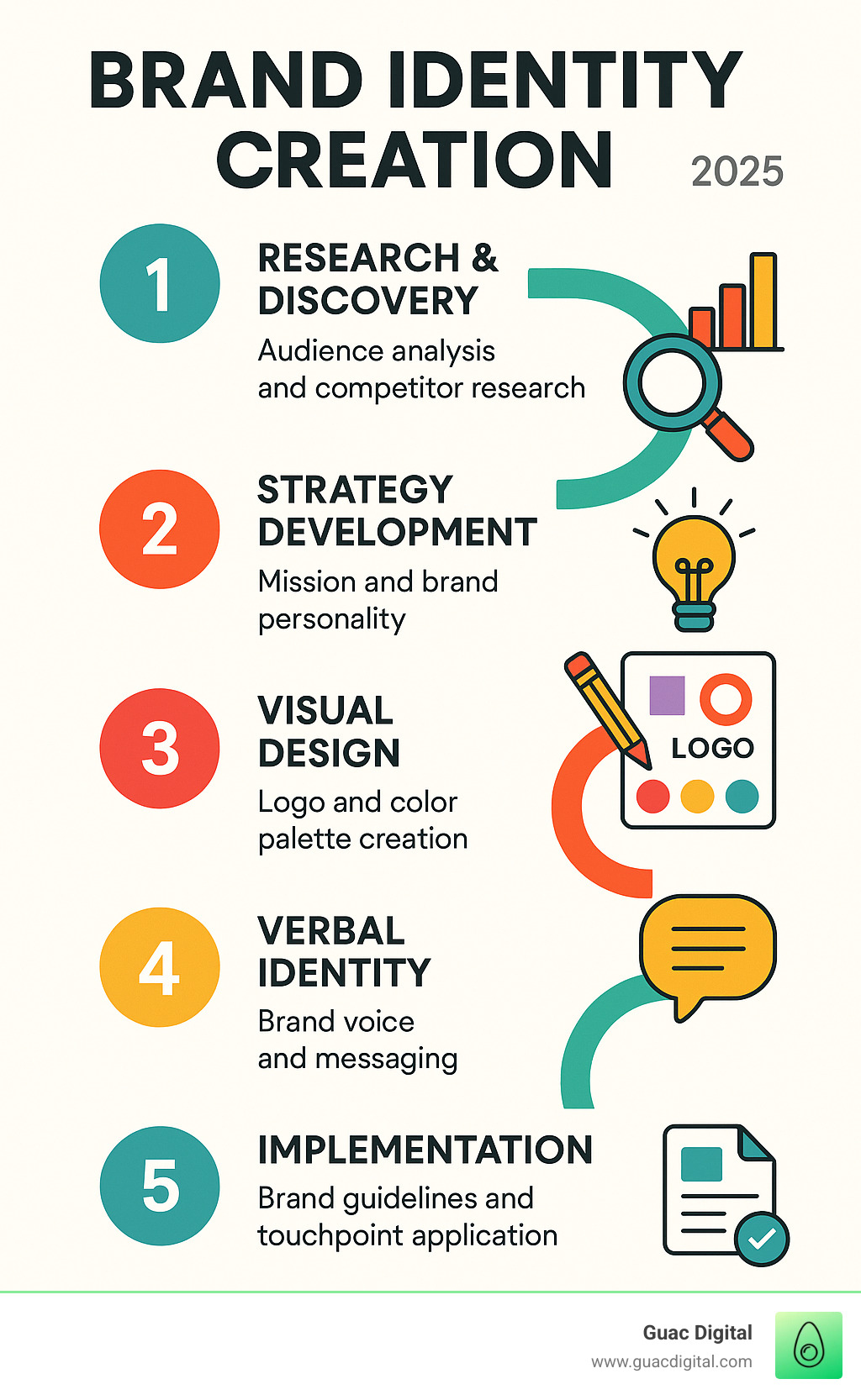
The process involves several key stages:
- Research & Findy: Understanding your audience, competitors, and market.
- Strategy Development: Defining your brand’s mission, values, and personality.
- Visual & Verbal Design: Creating logos, colors, typography, and a distinct brand voice.
- Implementation: Applying the identity across all touchpoints with clear guidelines.
Think of iconic brands like Apple or Nike. Their identities are instantly recognizable, demonstrating the power of this strategic investment. Many businesses falter by treating branding as a one-time task, focusing only on visuals while neglecting the underlying strategy that builds lasting recognition.
I’m Guy Leon, founder and CEO of Guac Digital. We’ve seen how strategic brand identity creation transforms businesses. Through our comprehensive digital marketing campaigns, we’ve helped clients achieve a 350 % boost in engagement by building unforgettable brands.
Understanding Brand Identity: More Than Just a Pretty Logo
Many people use “brand,” “branding,” and “brand identity” interchangeably, but they represent distinct concepts. Understanding these differences is the foundation of successful brand identity creation.
- Your brand is your reputation—what people think and feel about your company. As marketing expert Seth Godin says, “A brand is the set of expectations, memories, stories, and relationships that, taken together, account for a consumer’s decision to choose one product or service over another.”
- Branding is the active process of shaping that reputation through strategic actions.
- Brand identity is the tangible toolkit you create to represent your brand, including your logo, colors, fonts, and voice.
- Brand image is the result—the actual perception customers have formed about you.
Here’s a quick breakdown:
| Term | Definition | Purpose | Examples |
|---|---|---|---|
| Brand | The overall perception customers have of your company | Creates emotional connection and drives choice | Apple’s reputation for innovation, Nike’s association with athletic achievement |
| Branding | The active process of shaping your brand | Influences customer perception through strategic actions | Marketing campaigns, PR efforts, customer experience design |
| Brand Identity | The tangible elements you create to represent your brand | Provides consistent visual and verbal representation | Logo, color palette, typography, brand voice, messaging |
| Brand Image | How customers actually perceive your brand | Results from successful (or unsuccessful) branding efforts | Customer reviews, social media sentiment, word-of-mouth recommendations |
Why a Strong Identity is a Financial Asset
Strategic brand identity creation is a direct investment in your bottom line. Studies show that consistent brand presentation can increase revenue by 23 percent. Top brands like Apple and Coca-Cola are valued in the hundreds of billions, not just for their products, but for the power of their brand.
Furthermore, a study on millennial consumers found that brand image and trust are vital to purchasing decisions. A strong identity allows you to command premium prices, builds customer loyalty, and helps attract top talent, turning your brand into a valuable financial asset.
Understanding Brand Identity: Quick Refresher
When most people hear “brand identity,” they picture a sleek logo or matching colors. In reality, those are just the surface. To open up your brand’s true potential you must see four related but different concepts:
| Term | Definition | Purpose | Examples |
|---|---|---|---|
| Brand | The overall perception and reputation that lives in customers’ minds | Creates emotional connection | Apple = innovation, Nike = achievement |
| Branding | The actions you take to shape that perception | Directs how people think and feel | Campaigns, customer experience |
| Brand Identity | The tangible elements you design to represent the brand | Provides consistent visual & verbal expression | Logo, color palette, brand voice |
| Brand Image | The actual perception people end up having | Measures success of your efforts | Reviews, social sentiment |
As Seth Godin reminds us, “A brand is the set of expectations, memories, stories, and relationships that, taken together, account for a consumer’s decision to choose one product or service over another.” Understanding these distinctions keeps your brand identity creation focused, efficient, and profitable.
Why a Strong Identity Pays for Itself
Strategic brand identity creation isn’t just about aesthetics—it’s about revenue. Multiple studies show that consistent presentation can lift sales by around 23 %. Strong brands enjoy:
- Premium pricing power (customers pay more for perceived value).
- Better market resilience during downturns thanks to loyalty.
- Easier recruitment and retention of top talent who want to be associated with respected companies.
Apple, Nike, and Coca-Cola illustrate this on a global scale, but small and mid-size businesses experience the same pattern—just on a different order of magnitude. Invest wisely and the equity compounds year after year.
The Anatomy of a Strong Brand Identity
A strong brand identity is a system where visual, verbal, and experiential elements work in harmony. Whether a customer is on your website or in your store, the feeling should be consistent and authentic. For a deeper dive, see our article on the Elements of a Successful Brand Identity.

Visual Identity: The Look and Feel
This is your brand’s first impression. It’s the collection of visual assets that people see.
- Logo Design: The cornerstone of your visual identity. A great logo is simple, memorable, and versatile enough to work anywhere from a business card to a billboard. Learn more about creating impactful logos in our “Brand Identity and Logo Design” article.
- Color Choices: Colors evoke emotion and create associations. Blue often signals trust, making it popular with banks, while a tech startup might use a bold color to convey innovation. Understanding the color wheel helps create a palette that supports your business goals.
- Typography: The fonts you choose express your brand’s personality. Serif fonts can feel traditional and trustworthy, while sans-serif fonts often appear modern and clean. Consistency in typography, like Disney’s iconic script, builds instant recognition.
- Imagery Style: Your photography and illustrations are your brand’s visual language. Apple’s sleek product shots reinforce its premium identity, while Mailchimp’s quirky illustrations match its friendly personality.
Verbal Identity: The Voice and Story
If visual identity is how your brand looks, verbal identity is how it sounds.
- Brand Voice and Tone: Your voice is your consistent personality (e.g., authoritative, playful). Your tone adapts to the situation (e.g., formal in a press release, casual on social media). Our guide to “Creating a Consistent Brand Voice” explores this balance.
- Messaging and Storytelling: Messaging pillars are the core themes your brand communicates. Storytelling connects with customers on an emotional level. Frameworks like Donald Miller’s StoryBrand position the customer as the hero, with your brand as their guide.
- Taglines and Slogans: These short phrases pack a punch. Nike’s “Just Do It” is a masterclass in motivational branding. A 2023 study suggests that distinctive slogans are more memorable, highlighting the need for a unique and ownable phrase.
The 5-Step Guide to Brand Identity Creation

Building a powerful brand identity is a strategic process, not a guessing game. At Guac Digital, we follow five essential steps to guide clients from concept to a cohesive brand. For more detail, see our guide on How to Build a Strong Brand Identity.
Step 1: Research and Findy
This foundational step ensures your brand is built on insight, not assumptions.
- Audience Analysis: Go beyond demographics to understand your customers’ needs, challenges, and motivations by creating detailed buyer personas.
- Competitor Analysis: Study your direct business competitors to find what they do well and identify market gaps. It’s also wise to analyze the work of leading branding agencies like Pentagram or Wolff Olins to understand the high-level creative landscape and see how top-tier identities are built.
- Market Positioning: Define your unique place in the landscape. Are you the premium choice, the innovator, or the budget-friendly option? Use this brand identity worksheet to organize your findings.
Step 2: Strategy and Positioning
With research complete, you can define your brand’s core purpose.
- Define Your Purpose: Articulate your mission (what you do), vision (the future you’re creating), and values (your guiding principles).
- Develop a Personality: Humanize your brand. Is it a witty friend like Slack or a wise advisor?
- Craft Your Story: Create an emotional narrative that explains why you exist and what you believe in.
- Identify Your USP: Your Unique Selling Proposition is what makes you distinctly better than the competition. For more on this, Adobe’s Ultimate Guide to Brand Strategy is a great resource.
Step 3: Designing the Visual Elements
This is where your strategy becomes tangible.
Logo Creation: Choose a logo type—wordmark, brandmark, or combination mark—that best represents your brand’s personality and is versatile across all applications.
Color & Typography: Select a color palette that evokes the right emotions and one or two typefaces that reflect your brand’s tone. Ensure your choices meet Web Content Accessibility Guidelines (WCAG) for readability.
Step 4: Defining Voice and Messaging
Your visual identity grabs attention; your voice builds the relationship.
- Key Messages: Identify the core ideas you want your audience to remember.
- Tagline: Distill your value proposition into a short, memorable phrase.
- Voice & Tone Guidelines: Define your brand’s personality (voice) and how it adapts to different contexts (tone) to ensure consistency.
Step 5: Creating Brand Guidelines
Your brand’s instruction manual ensures consistency as you grow. This style guide should document:
- Logo Usage: Rules on sizing, spacing, and incorrect applications.
- Color Codes: Exact HEX, RGB, and CMYK values for digital and print.
- Typography Hierarchy: Rules for headlines, body text, and captions.
- Voice and Tone Examples: Sample language for different communication scenarios.
Adobe’s guide on creating a style guide offers more tips on building this crucial document.
Bringing Your Brand to Life: Best Practices & Pitfalls
Creating your brand identity creation masterpiece is just the first act. The real show begins when you consistently bring it to life across every customer touchpoint. Think of it like directing a movie – you need every scene, every actor, and every detail working together to tell one cohesive story.
The difference between brands that thrive and those that fade often comes down to execution. You can have the most beautiful logo in the world, but if it’s applied inconsistently or doesn’t align with your audience’s expectations, it won’t deliver results.
Best Practices for a Cohesive Brand
Consistency is your brand’s best friend. Every single interaction a customer has with your brand should feel like it belongs to the same family. When someone visits your website, opens your email, walks into your store, or unboxes your product, they should immediately recognize it as you.
Take Warby Parker as a perfect example. Their approachable, minimalist identity flows seamlessly from their website to their physical stores. The same clean fonts, thoughtful blue accents, and friendly tone appear everywhere. Whether you’re browsing frames online or chatting with staff in person, you know you’re experiencing the Warby Parker brand.
Your website becomes your digital storefront, so it needs to reflect your brand identity flawlessly. Fast loading speeds, clean layouts, and consistent visual elements aren’t just nice-to-haves – they’re essential. Your site should feel like a natural extension of your brand’s personality.
Social media requires special attention because it’s where your brand gets personal. Your handles should be easily recognizable, and your visual elements and voice must stay consistent with your overall identity. We dive deeper into this relationship in our article on Brand Identity and Social Media Marketing.
Don’t overlook packaging and physical touchpoints. That unboxing experience can turn a simple purchase into a memorable moment. A thoughtfully designed package or a handwritten thank-you note can spark social media posts and build lasting loyalty.
Your employees are walking, talking representations of your brand. They need to understand not just what your brand looks like, but what it stands for. Regular training on brand guidelines and values helps create authentic brand ambassadors who naturally embody your identity in every customer interaction.
Authenticity can’t be faked – and customers know the difference. Research shows that 91% of consumers want the brands they support to be genuine. Your brand identity should honestly reflect who you are as a business, not who you think you should be.
While consistency matters enormously, smart flexibility is equally important. Your brand identity should adapt gracefully to different contexts and platforms while maintaining its core recognition. A rigid brand that can’t evolve will eventually feel outdated.
Common Pitfalls to Avoid
Even well-intentioned brands can stumble into costly mistakes. Learning from these common pitfalls can save you significant time, money, and reputation damage.
Inconsistency is the silent brand killer. When your logo appears in slightly different colors across platforms, or your fonts vary from email to website, customers notice – even if they can’t articulate why something feels “off.” These small deviations chip away at professionalism and trust.
Playing copycat never pays off. While studying competitors is smart strategy, mimicking their identity makes you invisible in the crowd. Your audience chose them first for a reason – you need to give them a compelling reason to choose you instead.
Ignoring your audience’s voice is a recipe for disconnect. Your brand identity exists for your customers, not for you. When their perception doesn’t align with your intentions, it’s time to listen and adjust. Markets shift, preferences evolve, and staying rigid means getting left behind.
Complexity kills memorability. The most iconic brands in the world – Apple, Nike, McDonald’s – are instantly recognizable because they’re beautifully simple. Overcomplicating your visual elements or messaging confuses customers and makes your brand forgettable.
Refusing to evolve can be fatal in today’s fast-moving marketplace. Brand identities aren’t museum pieces – they’re living assets that need thoughtful updates. However, dramatic changes without proper research can backfire spectacularly.
The Gap learned this lesson the hard way in 2010 when their new logo generated such intense backlash that they reverted to the original within a week. Tropicana faced a similar fate when their minimalist packaging redesign caused a 20% sales drop, forcing them to quickly return to their familiar orange-with-straw design.
These failures highlight a crucial truth: your audience has an emotional relationship with your brand identity. Respect that connection, and any changes you make should improve rather than abandon what people already love about your brand.
Frequently Asked Questions about Brand Identity
At Guac Digital, we often field questions about the nuances of brand identity creation. Here are answers to some of the most common inquiries.
How do you develop the skills to become a brand identity designer?
Becoming a brand identity designer requires a mix of creative talent and strategic thinking. Key steps include:
- Mastering Fundamentals: Learn core design principles like color theory, typography, and layout through formal education or online courses.
- Learning the Tools: Become proficient in industry-standard software like the Adobe Creative Cloud, especially Illustrator, Photoshop, and InDesign.
- Building a Strategic Portfolio: Showcase your process, not just final designs. Use case studies to explain your thinking from research to execution.
- Gaining Real-World Experience: Seek internships, freelance projects, or pro bono work to learn how to balance creative vision with client needs.
How can a brand identity evolve over time without losing recognition?
The key is strategic evolution, not a complete overhaul. Treat it like a careful renovation, not a demolition.
- Refine, Don’t Replace: Make gradual, subtle changes to modernize your logo, color palette, or voice. This keeps the brand feeling fresh without alienating loyal customers.
- Preserve Core Elements: Maintain the most recognizable parts of your brand’s DNA. Coca-Cola has refined its logo for over a century, but the core script and red color remain, ensuring instant recognition.
- Respond to Market Shifts: Stay attuned to changing customer expectations and cultural trends. Spotify successfully evolved from a music service to a broader audio platform by updating its brand personality while keeping its distinctive visual identity.
How do you measure the success of your brand identity?
Measuring the ROI of brand identity requires a mix of quantitative and qualitative metrics.
- Brand Awareness & Perception: Use brand tracking studies to measure recognition and association. Are you top-of-mind in your category?
- Customer Loyalty: Track metrics like Customer Satisfaction (CSAT) and Net Promoter Score (NPS). A strong brand connection often leads to higher scores.
- Social Sentiment: Monitor online conversations to gauge whether your brand is resonating positively.
- Market Performance: Analyze your market share and ability to command a price premium compared to competitors.
For a detailed look at this topic, read our article on “Measuring the Success of Your Brand Identity.”
Conclusion
Brand identity creation is not just about aesthetics; it’s a powerful business strategy for carving out your unique space in the market. Building a strong brand is a continuous process, not a one-time project. It requires consistent nurturing across every touchpoint to build the trust that translates into customer loyalty and revenue. A unified brand experience ensures every interaction is building that trust.
While the branding world is vast, with global giants like Pentagram and countless specialized studios, the right partner is one that understands your specific market and goals. At Guac Digital, a Tampa-based agency serving clients globally, we specialize in creating powerful brand identities and custom digital campaigns. We know that a successful brand is built on a deep understanding of your audience, translating data-driven insights into every visual and verbal element. The brands that thrive are those that know their purpose and consistently deliver on their promise.
Your brand identity is waiting to be defined. The question isn’t whether you can afford to invest in it—it’s whether you can afford not to.
For expert help in leveraging data and creativity to build a powerful brand identity, explore our branding services. Let us help you craft a brand that connects, converts, and sticks.