
AI and SEO: How Artificial Intelligence Is Transforming Search Optimization in 2026
Quick Answer
AI and SEO work together to optimize website content through machine learning algorithms that analyze search patterns, predict user intent, and automate technical optimizations. In 2026, AI-powered tools handle everything from keyword research to content generation and predictive analytics, while search engines themselves use AI to understand context, semantics, and user satisfaction signals better than ever before.
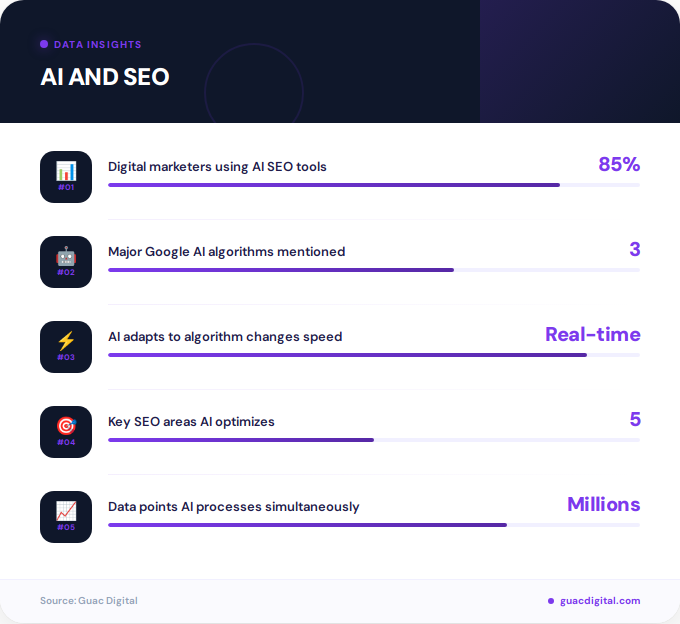
Over 85% of digital marketers now use AI-powered tools in their SEO workflows, fundamentally changing how websites rank and compete for visibility. The relationship between AI and SEO has evolved from simple automation to sophisticated systems that predict user intent, optimize content at scale, and adapt to algorithm changes in real time.
As search engines like Google integrate more AI capabilities into their ranking systems, understanding this intersection has become essential for digital marketers. Whether you’re managing SEO services for clients or optimizing your own site, AI is reshaping every aspect of search optimization, from keyword research to link building and performance analysis.
This comprehensive guide explores how professional SEO strategies leverage artificial intelligence to deliver measurable results in 2026’s competitive search landscape.
What Is AI SEO and How Does It Work?
AI SEO refers to the application of artificial intelligence technologies, including machine learning, natural language processing, and predictive analytics, to optimize websites for search engine rankings. Unlike traditional SEO that relies heavily on manual processes and human interpretation, AI SEO automates complex tasks and uncovers insights impossible for humans to detect at scale.
The technology works by analyzing massive datasets of search behavior, competitor strategies, and ranking patterns to identify optimization opportunities. AI algorithms can process millions of data points simultaneously, recognizing correlations between content elements and ranking success that would take humans months to discover manually.
According to Salesforce’s comprehensive AI SEO guide, these systems continuously learn from new data, adapting recommendations based on algorithm updates and shifting search trends. This creates a dynamic optimization approach that evolves with your industry and audience.
How Is AI Changing Search Engine Algorithms?
Search engines have fundamentally transformed their ranking systems through AI integration. Google’s RankBrain, BERT, and MUM algorithms all represent major shifts toward understanding search context rather than just matching keywords. These AI systems interpret semantic meaning, user intent, and content quality in ways that mirror human comprehension.
The most significant change is how search engines now evaluate content quality. Rather than simple keyword density or backlink counts, AI search engines assess websites based on topical authority and user satisfaction signals. This includes metrics like time on page, bounce rate, and engagement patterns that indicate whether content truly answers searcher questions.
Research from the Search Engine Journal’s analysis of AI citation patterns reveals that search engines now prioritize content that demonstrates expertise, authoritativeness, and trustworthiness through verifiable data, proper citations, and comprehensive coverage of topics.

What Are the Most Effective AI SEO Tools in 2026?
The AI SEO tool landscape has matured significantly, with platforms now offering end-to-end optimization capabilities. The most effective tools in 2026 combine multiple AI functionalities into comprehensive platforms that handle research, optimization, and performance tracking.
Leading solutions include content optimization platforms that analyze top-ranking pages and provide real-time recommendations, keyword research tools that predict search volume trends before they peak, and technical SEO crawlers that automatically identify and prioritize site issues based on their impact on rankings.
When evaluating AI-powered SEO service providers, consider tools that offer predictive analytics capabilities. These systems forecast ranking changes based on algorithm updates and competitive movements, allowing proactive strategy adjustments rather than reactive fixes.
| Tool Category | Primary Function | Key Benefit |
|---|---|---|
| Content Optimization | Analyzes top-ranking content | Real-time content scoring |
| Keyword Research | Predicts search trends | Early trend identification |
| Technical Auditing | Automated site crawling | Priority-based fixes |
How Can AI Improve SEO Content Creation?
AI has revolutionized content creation for SEO by enabling data-driven writing at scale. Modern AI writing assistants analyze search intent patterns across thousands of queries to determine exactly what information users expect to find, then structure content to match those expectations perfectly.
The technology excels at gap analysis, identifying topics your competitors haven’t covered thoroughly and opportunities to provide more comprehensive information. AI tools can scan the top 20 results for any keyword, extract common themes, and highlight missing elements that could differentiate your content.
However, according to insights from Siteimprove’s research on authoritative content intelligence, the most effective approach combines AI efficiency with human expertise. AI handles research, structure, and initial drafts, while human editors add unique insights, case studies, and the nuanced perspective that builds true authority.
Professional AI SEO implementations use content generation tools to produce briefs, outlines, and first drafts rapidly, then layer in proprietary data, original research, and expert commentary that competitors cannot replicate. This hybrid approach delivers both speed and quality.
How Does AI Handle Technical SEO Optimization?
Technical SEO has become increasingly complex, with hundreds of ranking factors spanning site speed, mobile usability, structured data, and crawlability. AI systems excel at managing this complexity by continuously monitoring technical health and automatically prioritizing fixes based on their potential ranking impact.
Advanced AI platforms now perform intelligent site audits that go beyond simple error detection. They analyze how technical issues correlate with ranking performance across your entire site, identifying which problems genuinely hurt visibility versus cosmetic issues with minimal impact.
Machine learning algorithms can predict how technical changes will affect rankings before implementation. By analyzing patterns from millions of websites, these systems estimate the ranking improvement from speed optimizations, schema markup additions, or site architecture changes with remarkable accuracy.
For businesses working with comprehensive SEO service packages, AI-driven technical optimization means proactive problem prevention rather than reactive fixes. The systems alert teams to emerging issues before they impact rankings and automatically suggest the most efficient resolution paths.
What AI-Driven Ranking Factors Should You Focus On?
As search algorithms become more sophisticated, certain ranking factors have gained prominence in AI-driven search environments. Understanding these priorities helps focus optimization efforts on elements that truly move rankings.
Content comprehensiveness and depth now rank among the most important factors. AI algorithms evaluate whether your content fully answers a query and addresses related questions users might have. Partial or superficial answers struggle to rank, regardless of technical optimization.
User experience signals have become critical ranking determinants. Core Web Vitals, mobile usability, and engagement metrics all feed into AI ranking models that assess whether users find your site satisfactory. Pages with poor UX metrics face ranking penalties even with excellent content.
Focus: Topic coverage breadth
Impact: Long-term authority
Focus: Core Web Vitals
Impact: Direct ranking signal
Focus: Regular updates
Impact: Maintains rankings
Focus: Author expertise
Impact: Trust and authority
Structured data and schema markup have become more important as AI search engines extract featured snippets and rich results. Properly implemented structured data helps AI systems understand your content’s context and present it directly in search results.
How Should Businesses Implement AI SEO Strategies?
Successful AI SEO implementation requires a phased approach that balances automation with strategic oversight. Starting with a comprehensive audit using AI tools establishes your baseline performance and identifies high-impact optimization opportunities.
The most effective strategy begins with content optimization, as this typically delivers the fastest results. Use AI tools to analyze top-ranking competitors, identify content gaps, and create comprehensive resources that provide more value than existing alternatives. Focus on topics where you can demonstrate genuine expertise.
Next, implement technical optimizations identified through AI auditing. Prioritize fixes that directly impact Core Web Vitals, mobile usability, and crawlability. These foundational improvements enable all other SEO efforts to perform better.
For businesses evaluating whether to build internal capabilities or partner with specialists, consider that professional SEO services typically provide access to enterprise-level AI tools and expertise that would require significant investment to develop in-house. The decision often depends on scale, complexity, and internal resource availability.
Ongoing optimization requires continuous monitoring and adaptation. Set up automated reporting through AI platforms that track ranking movements, traffic patterns, and competitive changes. Use these insights to refine your strategy monthly, focusing resources on tactics that demonstrate measurable ROI.
People Also Ask
Will AI replace SEO professionals?
AI will not replace SEO professionals but will transform their roles from manual execution to strategic oversight. The most successful SEO specialists in 2026 use AI tools to handle repetitive tasks while focusing their expertise on strategy, creative problem-solving, and providing the unique insights that algorithms cannot generate.
Can AI-generated content rank well in search engines?
AI-generated content can rank well if it provides genuine value, demonstrates expertise, and is properly edited for accuracy and originality. Search engines evaluate content quality based on user satisfaction rather than creation method, so AI content that meets quality standards and user needs can achieve strong rankings.
How much should businesses invest in AI SEO tools?
Investment in AI SEO tools typically ranges from $500 to $5,000+ monthly depending on business size, competitive landscape, and optimization scope. Most businesses see positive ROI when tool costs remain below 10% of their total SEO budget, with the balance allocated to content creation, technical development, and strategic planning.
What is the difference between AI SEO and traditional SEO?
Traditional SEO relies on manual research, analysis, and optimization, while AI SEO uses machine learning algorithms to automate these processes and uncover insights at scale. AI SEO also incorporates predictive analytics, natural language processing, and continuous learning capabilities that traditional methods cannot match.
How long does it take to see results from AI SEO strategies?
Initial results from AI SEO implementations typically appear within 4 to 8 weeks for technical optimizations and content improvements. Significant ranking improvements and traffic increases generally require 3 to 6 months of consistent optimization, with compounding benefits accelerating over time as topical authority builds.
Do small businesses need AI SEO tools?
Small businesses benefit significantly from AI SEO tools because these platforms level the playing field against larger competitors with bigger teams. AI automation allows small teams to accomplish optimization tasks that would otherwise require multiple specialists, making sophisticated SEO strategies accessible regardless of company size.
Frequently Asked Questions
What are the best AI tools for keyword research?+
The most effective AI keyword research tools in 2026 include platforms that predict search volume trends, identify semantic relationships between keywords, and analyze competitor keyword gaps. Look for solutions offering intent classification, search volume forecasting, and question-based keyword discovery to identify opportunities before they become saturated.
How does Google’s AI affect local SEO?+
Google’s AI algorithms for local search focus heavily on relevance, distance, and prominence signals. The systems analyze review sentiment, business category accuracy, and local content quality to determine rankings. AI helps Google understand local intent nuances, making it essential for businesses to optimize Google Business Profiles with comprehensive, accurate information and consistent NAP citations.
Can AI help with link building strategies?+
AI significantly enhances link building by identifying high-quality prospect sites, analyzing competitor backlink profiles for opportunities, and predicting which content types are most likely to earn natural links. AI tools also streamline outreach by personalizing communication at scale and tracking relationship development, making link acquisition more efficient and strategic.
What is voice search optimization in AI SEO?+
Voice search optimization involves structuring content to answer conversational queries that users speak to AI assistants. This requires targeting long-tail, question-based keywords, creating concise answer paragraphs, and implementing FAQ schema markup. AI tools help identify voice search opportunities by analyzing natural language patterns and predicting which questions users will ask about your topics.
How does AI SEO impact e-commerce websites?+
E-commerce sites benefit enormously from AI SEO through automated product description optimization, dynamic pricing analysis for competitive positioning, and personalized search result predictions. AI tools analyze conversion data alongside ranking metrics to optimize not just for visibility but for revenue, identifying which product pages and categories deserve the most optimization investment based on commercial potential.
What metrics should I track for AI SEO performance?+
Key AI SEO metrics include organic traffic growth, keyword ranking improvements, Core Web Vitals scores, engagement metrics like time on page and bounce rate, and conversion rates from organic search. Advanced tracking also monitors topical authority scores, featured snippet captures, and AI search engine citation rates to measure visibility in ChatGPT, Perplexity, and similar platforms.
Is AI SEO more expensive than traditional SEO?+
AI SEO tools add to initial costs but typically reduce overall expenses by improving efficiency and results. While premium AI platforms range from $1,000 to $10,000+ monthly depending on features and scale, they eliminate the need for larger teams and deliver faster results. Most businesses find that AI SEO provides better ROI than traditional methods despite higher upfront tool investments.
Key Takeaways
- AI has fundamentally transformed SEO from manual optimization to automated, data-driven strategies that predict trends and adapt to algorithm changes in real time.
- Search engine algorithms now use AI to understand context, semantic meaning, and user intent rather than simple keyword matching, requiring content that demonstrates comprehensive expertise.
- The most effective AI SEO strategies combine automation with human expertise, using tools for research and execution while adding unique insights that algorithms cannot replicate.
- Technical SEO benefits significantly from AI through intelligent auditing, prioritized fixes, and predictive analysis of how changes will impact rankings before implementation.
- Content comprehensiveness, user experience signals, and E-E-A-T factors have become the dominant ranking factors in AI-driven search environments.
- Implementation should follow a phased approach starting with content optimization, followed by technical improvements, and supported by continuous monitoring and adaptation.
- Investment in AI SEO tools delivers positive ROI when costs remain proportional to overall SEO budgets and focus on platforms that provide actionable insights rather than just data collection.
Ready to Transform Your SEO Strategy with AI?
The intersection of AI and SEO represents the future of digital visibility. Whether you’re looking to implement AI tools internally or partner with specialists who leverage these technologies daily, the time to act is now.